Showing posts with label Piotr Leschenko. Show all posts

Friday, January 26, 2018

Ojos negros que fascinan, from 1830s to 1930s and beyond

In this story:

Readers of this blog may be aware that I've been working on the unusual history of "Ojos negros" for quite some time. It is a beautiful Golden Age Argentine Tango with a storied past from the Golden Age of Russian Romance... A tango classic recorded in Buenos Aires by the prolific Francisco Canaro in 1935 was a Spanish-German remix of a Russian song arranged by a Dane for a Romani choir, setting a verse of a Ukrainian poet to a Polish-Lithuanian waltz which successfully masqueraded as French. This post attempts to put in one page, in English, all bits and pieces of my research on the riddles and mysteries surrounding the "Dark Eyes", a song about fatal love and perdition which almost prophetically touched most of the talents who ever touched it, making them vanish from history. The project is nearly complete. Let's unravel this convoluted story thread, starting from near its end, from 1935. We'll end up time-traveling a full century back in time before it's over.

Manuel Salina y Florian Rey
1934

Ojos negros que fascinan; 
ojos negros que dominan; 
ojos negros, dulces ojos 
son tan crueles y tan piadosos.     

Ojos negros que arrebatan; 
ojos negros que me matan; 
ojos negros, dulces ojos, 
triste vida de mi corazón

Voy pasando por mi vida atormentada 
bajo el fuego abrasador de tu mirada, 
voy cruzando por la vida 
como una pobre sombra perdida. 

En el fondo de mi alma ya no brilla 
más que el fuego abrasador de tu pupila;
en el fondo de mi alma,
donde siempre tu amor vivirá.

Translation by Alejandro Sasha Vicente-Grabovetsky
creator of Tango Translation Database

Dark eyes that enchant;
Dark eyes that dominate;
dark eyes, sweet eyes;
they are so cruel and so kind.

Dark eyes that captivate;
dark eyes that kill me;
dark eyes, sweet eyes;
sad life of my heart.

I pass through my tormented life
under the scorching fire of your gaze,
I walk across life
like a poor, lost shadow.

In the bottom of my soul now shines
but the scorching fire of your pupil
in the bottom of my soul
where your love will always live
Odeon's 1935 disk 4939-B describes Canaro's "tango con estribillo" (tango with a short vocal section) as "Ojos negros que fascinan" authored by Manuel Salina and Florian Rey. But peculiarly, no such song can be found in the SADAIC database. As it turns out, the song was first recorded a year earlier, under a completely different title. It was called simply "Russian romance (Dark eyes) inspired by a Russian folk motiff" ( "Romanza rusa  (Ojos negros), Sobre un motivo popular ruso" ). This "Russian romance in Spanish" wasn't issued on a disk. Instead, the recording came out in the revolutionary format of "a 1934 Youtube" as a short standalone movie clip, one of the earliest "talkies" in Spanish language. Famous Spanish movie director Florian Rey cast his lead actress (and fiancee) Imperio Argentine in this film clip. Rey (born Antonio Martínez del Castillo) was a great fan of Russian culture (and a sworn enemy of the Left, who soon moved to Germany on Hitler's personal invitation. But when the fuhrer started making advances at his beautiful Argentine wife, it ended up in a divorce and a low-key return of the director to oblivion in his home country) 


Imperio Argentina, born Magdalena Nile del Rio (and known to her friends as Malena) specialized in folkloric song and dance on stage and on screen. She proudly declared herself the only woman who ever sung together with Carlos Gardel, the iconic symbol of Argentine tango (They performed together in a Spanish-language talkie made in Paris in 1935, "Melodia de arrabal"). She wrote that, although Gardel was rumored to be gay, his problem with female singers stemmed from simple dislike of their voices ... but even Gardel couldn't resist the feminine magic of his beautiful dark-eyed compatriot. It was after the Parisian adventure that Florian Rey decided to cast her in a short movie with a Russian-Spanish folk song stylized as Argentine tango. The original Russian romance already reverberated across the world after Feodor Chaliapin's tours. The legendary opera bass is said to have added several new stanzas, in adoration of his dark-eyed Italian wife Iola Tornagi. For Iperio Argentina's Dark Eyes, the song was arranged by Manuel "Paco" Salina, a Spanish songwriter and composer of German extraction, whose birth name was Gunther Ehrenfried Salinger. Salina was well known by his adaptation of other composers' music to popular styles. With their only foray into tango, Salina and Rey have made quite a remarkable job. Of course, being true to the Argentine tradition of his day, Francisco Canaro has retained just one bridge-estribillo in his recording, completely skipping the verse stanzas. 

Time to travel deeper into the past now. From this point on, the poems we'll encounter will all be in Russian. We are going to 1928, to Paris and Riga! Or, for that matter, let's head straight into 1893, to Dvinsk (presently Daugavpils in Latvia), then a county seat of Russia's Vitebsk Gubernia. On the 17th of the month of Tevet, year 5653 of the Jewish calendar, the youngest son is born into a big family of a musician Dovid bar Morduch Strok. Little Osher will in time become Oscar Davidovich Strok, the King of Russian Tango.
Dvinsk was a garrison town with a giant fortress and armory, and Dovid Strok moved there for a job of a military musician, but by the time of Oscar's birth, his father and his older brother worked in a theater orchestra. 
The Russian 1897 Census sheets were supposed to be destroyed, but the sheet enumerating the Stroks of Dvinsk
has miraculously survived. Osher, age 4, is on line 8.
"Rigas Tango Karalis": A memorial plaque honoring
King of Tango Oscar Strok is unveiled in Riga in 2013
Oscar Strok followed the footsteps of his musical clan, but he only wrote his first (and, in my opinion, the best) tango at the age of 35. It was "Dark Eyes", a different tango drawing on the same Russian song.
A hot romance with a secretary of his Riga-based magazine, Leni Libman, lead Oscar to abandon his family and to escape to Paris with his dark-eyed girlfriend. That's where he fell under the spell of Tango. That's where he composed his "Dark Eyes", complete with an extensive musical quote from the classic Russian romance.
The love to the dark eyes, as every superstitious Eastern European knows, couldn't portend any good. All what it gave Strok was a wounded heart, a pile of debts ... and this one unforgettable tango, with the lyrics completed by Oscar's friend and fellow Riga entertainer, a Cossack Yesaul (chieftain) Aleksandr Perfilyev, a heir to a famed line of Siberian explorers.


Оскар Строк, Александр Перфильев
1928

Был день осенний,
и листья гpустно опадали
В последних астpах 
Печаль хpустальная жила
Гpусти тогда с тобою мы не знали 
Ведь мы любили и для нас весна цвела.

Ах, эти чеpные глаза меня пленили,
Их позабыть нигде нельзя,
Они гоpят пеpедо мной.
Ах, эти чеpные глаза меня любили
Куда же вы скpылись бы тепеpь,
Кто близок вам дpугой.

Ах, эти чеpные глаза меня погубят,
Их позабыть нигде нельзя
Они гоpят пеpедо мной.
Ах, эти чеpные глаза, кто вас полюбит,
Тот потеpяет навсегда
И сеpдце и покой.

Очи чёрные, очи страстные,
Очи милые и прекрасные!
Как люблю я вас, как боюсь я вас!
Знать, увидел вас в недобрый час!

...Ах, эти чеpные глаза, кто вас полюбит,  
Тот потеpяет навсегда
И сеpдце и покой.

Oscar Strok, Alexander Perfilyev.
"Dark Eyes" tango

It was an autumn day
With leaves falling, dejectedly,
And in the last chrysanthemums 
Lurked a sad sparkle of frost
But the two of us didn't know sadness yet 
For we were in love, and our spring was abloom

Oh the dark eyes that captivated me,
One can't forget them anywhere;
They are ablaze before me.
The dark eyes which once loved me,
Where are you hiding now?
Who else is close to you?

Oh, the dark eyes will spell my doom,
One can't forget them anywhere;
They are ablaze before me.
Whoever falls in love with the dark eyes
Shall lose forever 
One's heart and one's peace

Dark eyes, eyes of passion,
Dear and beautiful eyes!
How I love you, how I fear you!
I think I met you in an ill-fated hour!

...Whoever falls in love with the dark eyes
Shall lose forever 
One's heart and one's peace
Piotr Leschenko, a Russian singer from Romania, also drawn to Riga by a potent cocktail of love and tango, made the most famous recording of this song in Austria, with Frank Fox - born Franz Fux in today's Czech Republic, then Moravia  - who conducted an orchestra and composed music for dancing and for movies in Vienna.
Piotr Leschenko's bootleg records were immensely popular - albeit technically illegal - in Russia, but he only set foot there under most tragic circumstances, as a Romanian conscript in the Nazi-allied occupation forces in WWII. Despite this stain of being a collaborationist, Leschenko was offered forgiveness and a clean slate in the Soviet Union after the end of the war. But at his farewell party, the singer confessed his love to Romania too eloquently. A snitch denounced him, and the Russians withdrew the invitation at the last moment. Instead, Leschenko has been sent to the Romanian labor camps. He died in a prison hospital, and his case remains classified even now. In a recent Russian bio-pic, Piotr Leschenko is pictured as a proud defender of Russian culture under the Nazi yoke, and Konstantin Khabensky re-enacts his "Dark Eyes" for the movie:
Decades later, Strok's "Dark Eyes" made it all the way to Argentina as well, in a powerfull instrumental cover by Florindo Sassone's orchestra:

Oscar Strok was once erased from the official history of the Russian song as well, when in the late Stalin's years he was blacklisted and forbidden from composing as a punishment for his "bourgeois degraded music of tango", and forced to earn living by private piano lessons. The very word "tango" was proscribed, replaced by a euphemistic "slow dance"! Still, now we know Strok's biography in great detail. But after the next leg of our time travel, we are going to make do with lots of guesswork about all characters of the story.

Let's hire a troika and order the coachman to race up Tverskaya Street! We are in the 1880s Moscow and we're heading to the famous suburban restaurant, the "Yard". We leave the old city boundaries, and the restrictions of the municipal ordinances, behind, once we pass the New Triumphal Gate Square. As a different folk song about the Yard wishes, "May the raven-black horses fly me away to the place where the girls are mischievous and the nights are full of fire".
From the census of merchants of Moscow's Butchers Quarter:
Tranquille Yard, the restaurateur, arrived from abroad in 1826
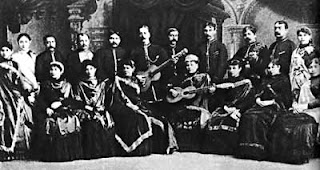
The Yard, once extolled by Pushkin for its truffles, has by now become most famous for its Romani singing.  It's partly due to the discriminatory laws of the 1850s which essentially made concert performances off limits for the Gypsy entertainers, confining them to taverns for 3 long decades. Even the revered Sokolov Gypsy Choir, once the darlings of the illustrious XVIII c. Count Orloff, had to settle on singing in a restaurant (although the most classy of them all, the Yard). It was the musical directors of the Yard's Choir, prolific songwriters Sergey (Sofus) Herdahl (Gerdal) and Yakov Prigozhiy, who made "Dark Eyes" an exemplary Gypsy romance song.
The 1884 music sheet of Gerdal's "Gypsy Romance" "Dark Eyes, Passionate Eyes",
from a livejournal entry of a Russian researcher
In 1884, Sofus Gerdal publishes his"Gypsy romance for voice and piano", "Dark Eyes, Passionate Eyes", crediting long-deceased Evgeny Grebenka for the lyrics, and using the music of Florian Hermann's "Valse Hommage". The same year, Yakov Prigozhiy publishes a different arrangement of the same music as "a waltz for voice with piano accompaniment", titled "You're My Heaven on Earth" ("Ты мой рай земной"). The lyrics ought to be different in Prigozhiy's waltz, but we'd need to go to the Russian National Library, which has the published score, to figure out if any of its lyrics were retained in the countless later covers of "Dark Eyes". And there is one more "Dark Eyes" song by Sofus Gerdal, published a bit earlier, in 1881, "for choir and piano", which doesn't credit either Evgeny Grebenka or Florian Hermann, but attributes the lyrics to a female author known only by her initials. We don't know yet if the 1881 score is essentially the same song or something entirely different; only a trip to the Russian National Library may sort it out. At least it's clear that Gerdal was the first in styling the song as a Gypsy romance, and that the lyrics started changing very early on, perhaps in Gerdal's own arrangements, perhaps in Prigozhiy's. Only the immortal opening stanza of Grebenka's lyrics remained a constant in all of the song's versions.

Evgeny Grebenka (Yevhen Hrebinka) 
1843

Очи чёрные, очи страстные,
Очи жгучие и прекрасные!
Как люблю я вас, как боюсь я вас!
Знать, увидел вас я в недобрый час!

Ох, недаром вы глубины темней!
Вижу траур в вас по душе моей,
Вижу пламя в вас я победное:
Сожжено на нём сердце бедное.

Но не грустен я, не печален я,
Утешительна мне судьба моя:
Всё, что лучшего в жизни Бог дал нам,  
В жертву отдал я огневым глазам!

Dark Eyes
Metrical translation by Stefan Bogdanov

Oh you dark black eyes, full-of-passion-eyes
Oh you burning eyes, how you hypnotize
Now I love you so, but I fear you though
Since you glanced at me not so long ago.

Oh I see you now, you are dark and deep
I see grief and feel that my soul will weep
I see now in you a winning burning glow
In my poor heart will a fire grow.

I’m not sorrowful, I’m not repenting
I accept all that my fate’s presenting
All the best in life, God has given us-
this I sacrifice, to you dark black eyes.


But any semblance of clarity disappears once we turn to the published biographic info about the arrangers, Gerdal and Prigozhiy, and the composer Hermann.
Sofus Gerdal published gypsy romances in Moscow in the 1880s, and worked at the Yard restaurant, but who he was and from where? An Internet legend, which started out as an innocent joke, is now repeated all across the Russian Internet as a "true discovery". The pianist sometimes Russified his name as "Sergey", and a few later editions misspelled his surname as "Gerdel". And so once, a search engine showed that Sergey Gerdel was alive and well (a contemporary entrepreneur with exactly this name lives and works in Berdichev in Ukraine). A classic Russian meme is the joke that "all the imported goods were actually made in Jewish Odessa". Likewise, a blogger who made the 2011 "Gerdel discovery" exclaimed, "What if all the classic Gypsy songs were, likewise, actually made in Jewish Berdichev". Alas, a harmless internet joke, repeated and reposted over and over again, began to sound like truth.  In reality though, there is no such Jewish surname as Gerdal, nor a Jewish personal name like Sofus (a rare Ashkenazi surname "Gerdel" does exist, but its area of origin was quite far from Berdichev, in Czarist Russia's Taurida Governorate). Sofus or Sophus is a male name in Scandinavia, Germany, and Belgium, a masculine version of the name Sophie. Gerdal (Гердаль) is a regular Russian alphabet rendition of a common Scandinavian surname "Herdahl", literally "Hay Valley". In Danish town of Maribo, there is even a record of a different Sofus Herdahl, a XIXth century barber. But was our Gypsy pianist Sofus Herdahl a Dane, or possibly a Swede, we can't yet tell.
Yakov Fedorovich Prigozhiy (1840-1920, Moscow) - this is how encyclopedias define the author and arranger of countless Russian and Gypsy romances, another one of which ("My campfire glows in the mist", "Мой костер в тумане светит") also got a second life in Argentine tango music. Better than nothing, although who he was, where he came from and grew up, remains a riddle. A little is also known about Yakov's relatives. His musician brother Adolf Prigozhiy was, at the peak of his fame, even better known than Yakov. All Russia danced to Adolf's waltzes, he toured the provinces, at one time owned an operetta theater in Vilna, and was married to an operetta star Serafima Beletskaya (who, after Adolf's untimely death in St Petersburg, remarried to a famous operetta actor, nobleman Gabel' -Rodon). Adolf's son George Prigozhiy clerked in the National Bank in St. Petersburg in 1899-1900. With these name / marriage / occupation tidbits we may conclude that Prigozhiy (which means "Handsome" in Russian) was their actual surname rather than a theatrical pseudonym, that they weren't ethnic Romani, and that they were Christians. A surname "Prigozhiy" did exist in Czarist Russia, mostly in Eastern Belorussia, home to many other "Good / Nice / Pretty" names (Among my own relatives in that region, one of the surnames was "Neplokh", literally Good-Enough). As with many other regional Slavic surnames, Prigozhiy was used both by Belorussians and Jews. The former mostly in Vitebsk Governorate, the latter mostly in Mogilev Governorate. Personal names Adolf, Yakov, and Fedor and especially Georgy weren't yet used by the Jewish residents of Russia at the time, but could have been used by Christian converts. The name Adolf was traditionally Polish but perhaps occasionally used by educated Belorussians, emulating their Polish landlord class. All this said, we still don't know the native community of the Prigozhiy family (and since the genealogical documents were kept by a parish, we don't  have a clear idea where to look for Yakov's childhood, education, and personal life).

A band of Dauldzhi, Crimean Romani musicians
But there is an Internet legend about the origins of Yakov Prigozhiy, too, and a beautiful one. It is said that the Karaims of Crimea consider him one of their own, a scion of Evpatoria Karaite community!
At a first glance, the Evpatoria hypothesis shows an intriguing similarity with the facts. In the city of Evpatoria, there was indeed a Jewish Prigozhiy family, even one Yakov Prigozhiy among them (albeit from a different generation). Yakov Prigozhiy the songwriter collaborated with musicians from Crimea. And the regional Gypsy, Tatar, and Jewish folk music was a one nearly indivisible phenomenon, because Crimean Tatar Gypsy musicians - called the Dauldzhi, from the name of the traditional large double-headed drum known as daul or davul - performed all these ethnic styles. Whosoever celebrates a wedding, would get one's folk music from the same band of Dauldzhis. "Same musicians, slightly different results".
But the putative Evpatoria Prigozhiy connection failed a reality check. This family moved to Evpatoria much later, and they were Ashkenazi Jewish rather than Karaim. They came from Bryansk and Mglin counties, at the boundaries of the same Mogilev Governorate (with Yakov making the move to Evpatoria only after WWII, while his sisters stayed put in Bryansk region). And no such surname ever existed among the Karaim.

Plaques with Hebrew inscriptions in the
Marble Courtyard of the Grand Evpatoria Kenasa 
But the Evpatoria hypothesis refuses to die. According to Karaim amateur historians, the Grand Karaite Kenasa of Evpatoria has a memorial plaque honoring a donation made by Yakov Prigozhiy the musician "to the community of his parents, may their memory be blessed". However, the family name is said to be spelled differently on the plaque. It is Yefet rather than Prigozhiy. Yefet (יֶפֶת) is of course Japheth, the Biblical son of Noah and the mythical ancestor of Tatars, Armenians, Greeks and pretty much all the ethnic groups of old Crimea. Yefet was also the name of one of the most revered Karaite Medieval scholars. And the men's name Yefet was quite popular among the Crimean Karaim. But the surname Yefet appeared in Evpatoria only in the late 1830s, brought by a family of a repatriant from Istanbul, r. Yufuda Yefet Kosdini. Reb Yufuda, a.k.a. Yehuda Qustini Yefet, was an Istanbuli Karaim wise man of Crimean origin and a close associate of Avraham "Eru" Firkovich, a Lutsk Karaim pilgrim, historian and reformer of their belief system. Qustini or Kosdini was a Greko-Karaim for "Konstantinopoli", "from Istanbul". Firkovich spent the first half of the 1830s in Istanbul, then the prime center of Karaite learning, but his reform zeal eventually caused him and his followers to be expelled. They moved to Crimea, and, in 1837,  made Evpatoria the center of Karaite religious autonomous community. That's when the Grand Kenasa was built, too. Now, is it possible that the first sons of the religious zealot repatriants have become operetta and night club musicians? Before you tell me that I'm totally nuts, I shall ask you to travel to Crimea and to send me a picture of the יֶפֶת stone. And then, to your valid question, how could "Yefet" ever become "Prigozhiy", the Karaim informants have a ready answer. Both words mean "Handsome", the first one in Hebrew, the second one in Russian.
From the glossary of Karaim surnames from the 1913 volume of "Jewish antiquities" (Еврейская старина).
It does mark "Yefet" as "handsome", albeit with a question mark. The more recent sources just mark it as a
surname derived from the male personal name Yefet in Istanbul
In the end it's the same story with Prigozhiy as with Gerdal... a cool legend finds no support, and we have no clue who they were.
But if the scale of myth-making surrounding Sofus Gerdal and Yakov Prigozhiy surprises you, then just wait until you listen to the tall tales about Florian (or Feodor) Hermann, whose "Valse Hommage" has been arranged into a romance song by the Yard's pianists!

Most often, we are told that Hermann was French, and came to Russia with Napoleon's Grand Army. Sometimes we hear that his Valse Hommage started as a march of the advancing French troops in 1812. But sometimes, that it mourns the French army losses as it forded the icy Berezina river on retreat from Moscow. We even hear that Florian Hermann visited the home estate of Evgeny Grebenka, the author of the lyrics of the future song, during the Napoleonic Wars! But sometimes Florian Hermann turns out to be a German rather than Frenchman. We are even told that the lived in Strasbourg. One has to note that "Valse Hommage" is always titled in French in the international score catalogs, while some of the other Hermann's compositions are titled in German. However, my research shows that Florian Hermann was a Slavic patriot from the Wilno strip area of Poland / Lithuania, and that he composed some of his most popular pieces in 1870s through 1890s. And very recently, I was able to find out a few details about his youth and his family in Wilno (now Vilnius, Lithuania)

The path to discovering Florian Hermann's real story started from the numbered lists of his works, available from the sheet music publishers. Some of these compositions had obvious connections to historical events and geographical locations. For example, "March over the Balkans" and "Totleben March" (Забалканскiй Маршъ & Тодлебенъ-Маршъ) - Florian Hermann op. 37 & 39, resp. - are clearly linked to the Balkan Campaign of the Russo-Turkish War of 1877-1878, when the nation rose up in the wave of Pan-Slavic patriotism, the Czar's army crossed the Balkan Mountains, and general Totleben wrestled the key fortress of Plevna from the Turks). The "March of Russian volunteers" also glorifies the liberator warriors who saved the Balkan Slavs from the Turkish yoke. One of the latest compositions of Hermann honors the coronation of Nicholas II in 1896.

The scores of Hermann's were being printed by the Moscow publishing house of Gutheil,  which also issued the works of Gerdal and Prigozhiy. But the best source on Floriann Hermann is the St. Petersburg publishing house of Buttner, which in 1879 merged with D. Rahter Publishers of Hamburg. As a result, their catalogs were printed in Hamburg, and survived the ravages of time much better than the Russian rarities. We don't see any new works of Hermann after 1900.

Op. 60 - 2nd Lithuanian Quadrille - was inspired by the vocal polonaises of Stanisław Moniuszko, the leading composer of Polish Nationalist Romanticism, whose folkloric operas were all the rage in the 1860s.  Op. 56, the "Evening Chant", had a dedication to Moniuszko as well.  Stanisław Moniuszko died in 1872 and attained an even higher post-mortal glory as the Polish creator of the Pan-Slavic music. It was easy to see that the same musical ideology attracted Florian Hermann as well. In addition to patriotic an Pan-Slavic marches and Western European themes, his list of compositions is thick with Lithuanian, Ukrinian / Belorussian (Op. 30 and 52 are"Little Russian polkas"), Polish and Russian folkloric-romantic themes. Polonaises, mazurkas, polkas... Op. 61 was dedicated to Rubno (a backwoods village with a manor of the Dauksza family on the outskirts of Vilnius, now called Kirtimai, where, as we will soon see, the Hermanns also lived; both Rubno and Kirtimai mean "Clear-cut", in Polish and Lithuanian, resp). General Totleben, lionized in op. 39, was based in Vilnius, too. The most remarkable edition of Florian Hermann's music came out in 1881 from the famous Wilno publishing house of Eliza Orzeszkowa, a Polish freedom fighter who barely avoided exile for her role in the Uprising of 1863, author, and an ideologist of Positivism, a school of Polish nationalist thought which insisted that the future of Poland depended on its cultural growth and fostering cultural ties between its ethnic groups, rather than on continuing armed uprisings. Eliza Orzeszko's publishing house was quickly shut down by the Czarist government, but not before they issued a beautiful booklet of Hermann's "salon dances", entitled "Wilno Carnival", with a panoramic view of the city on its jacket, and 6 patriotic compositions inside: Lithuanian countradance, Fiery mazurka, two dances for the local rivers Vilia and Niemen, and two more glorifying Lithuania's pre-Christian past (dedicated to a Pagan priestess and the thunder-deity Perkunas). More dedications to Moniuszko are found inside this 41-page booklet.

One of Napoleon's 1812 Campaign
drawings made by Moniuszko's
father Czeslaw
As I researched more, I was stunned to discover Stanisław Moniuszko's strong association with Vilnius. The young composer (who, by the way, was really a son of a Napoleon's officer - for his secessionist father joined the war against Russia as a Captain of Lithuanian Mounted Riflemen) came to Vilnius fresh after school, at the age of 21, for a modest job of a church organ player. As we'll soon discover, Moniuszko was just 3 years older than Florian Hermann. Stanisław would stay in Vilnius for nearly two decades, supplementing his income with teaching music (but often teaching without pay). He married a local German noble maiden, and Moniuszko's - or rather his in-laws' - mansion on German street quickly became the hub of Wilno's musical life. (Later we'll learn that the Hermanns lived literally next door, and that the two teachers passed students to one another. I suspect that Florian Hermann didn't just find inspiration in his neighbor's music but also studied composition with the gifted and generous, but not yet famous, Stanisław Moniuszko)
Moniuszko's (actually his father-in-law Muller's) house on 26 German st. on Vilnius.
In the 1820s, the Hermans were next-door neighbors
Florian Hermann's early compositions were dedicated to Lydia, Yulia, and Sofiya (presumably students of Florian) which makes it likely that the composer worked as a piano teacher in his youth. As to the Hommage-vals (future "Dark eyes"), op. 21... it was undoubtedly composed before the mid 1870s, and it was a very popular composition, judging by a variety of "updated" and orchestral arrangements in Rahter-Buttner catalogs.

The old Vilnius high school courtyard
The Vilnius connection of Florian Hermann already loomed large, but the breakthrough came when I was lucky to find the earliest, student's work of Florian Hermann in the catalog of the former Imperial Libary. An 1840 polonaise has been dedicated (in French) to Ustinov, the principal of Wilno Gymnasia (High Scool) "from his humblest pupil Florian Hermann", printed at Michal  Przybyłski's lithography shop. (dédiée du m-r Ustinoff, directeur du Gymnase imperial du gouvernement de Vilna, conseiller de la cour et membre de plusieurs ordres et composée pour le piano-forte par son très humble élève Florian Herrmann. - Vilna : lith. de Przybyłski). The 1840 date may have been inexact, but this was when the work was added to the library collection. Yet it's known that Alexandr Ustinov, a painter and an educator, served as the Principal of the 1st Wilno Men's Gymnasia from 1836 to 1843. There are also other known lithographic sheet music editions by the Przybyłski shop, dated by the 1830s. Therefore it appeared that Florian Hermann was the composer's real name, and that he studied in a high school in Vilnius in the late 1830s.

Only a privileged family could have sent their sons to a high school in the 1830s-1840s. So, having failed to find the Hermans in the XIX c. lists of local officials or merchants, I tentatively concluded that they must have belonged to the szlachta, the Polish-Lithuanian landed gentry. Of note, a leading Polish genealogist Iwona Dakiniewicz spotted this surname in the vital record books of the Catholic Deanery of Wilno as early as in the 1740s. Iwona wrote that their home parishes may have been North of town, in Giedrojcie or Podbrzezie. Indeed, I soon found a mention of a local nobleman Sykstus Herman in an 1844 Imperial government publication. These exciting finds later turned out to be "false alarms" from a different Herman family, but it still moved my search into the right direction! 
From the list of Nobleman Assembly electors, Wilno, 1834

"The Chase", old Lithuanian
coat of arms, graces the
Holy (or Dawn) Gate 
Iwona Dakiniewicz introduced me to a prominent Lithuanian genealogist Sigita Gasparaviciene, who told me of one Herman nobleman who lived in Wilno proper in the beginning of the XIX c. This Piotr Herman, a transplant from Warmia, didn't belong to the hereditary szlachta; rather, he was a former merchant, elevated to the noble status in honor of his service on Wilno Magistrate. This turned out to be a false lead, too. But then, on the website of Czeslaw Malewski, a specialist on Lithuania's szlachta, I saw in an 1834 list of Nobleman Assembly voters that the former Head of Wilno Gentry, travelling to the assembly from a distant county, stopped at the Hermans' house at Ostrobramska Street, right in the heart of Wilno's Old Town, famous for its Holy / Sharp / Dawn Gate as it's known in various local languages!
Florian Herman lived here? (Ostrobramska street at the Gate in the 1840s) 
Florian Hermann, 14, in his 1835/36 high school class roster
I emailed Czeslaw Malewski, who confirmed that in 1835/36 school year, Florian Herman, age 14. a Catholic Wilna nobleman, studied in Wilna Gymnasia in IV grade. And within weeks, we had the whole story of this Herman family pieced together at last! His was born in Vilnius in 1822 to Johann Herman, a German transplant, and Eleonora nee Marianski, an ethnic Polish noblewoman. Florian was the 3rd of their 4 children. His father Johann (known in Polish records as Jan and in Russian ones as German), born ca. 1787, was a school teacher. He studied in Dresden (Saxony) and Breslau, and then in the Kingdom of Prussia. He started teaching in Vilna in a German Lutheran school on Sept 1st, 1812. He married Eleonora, also from a noble Catholic family, in 1819. Notably, Jan Herman also taught in the only Polish-language high school still allowed in the city after the severe crackdown on Polish education in the wake of the 1831 Uprising. In 1839 he was required to pledge allegiance to Russian Empire to save his nobleman status. Ivan Herman continued teaching in a Lutheran school, retiring in the mid-1840s with the government service rank of Titular Councillor, and then opening his own private school. He died in 1860 (and his death record lists him as a parishioner of the German-speaking Congregation of St. Martin), and his widow passed away in 1867. They are buried together with their children, including Florian Hermann, at the decaying Bernardine Cemetery in Vilnius, where their tombstones still remain to be identified.
Three elements of these records offer particularly insightful windows into the history of the epoch and the life of Florian Hermann: that Jan Hermann's teaching job in Vilnius commenced just as Napoleon readied his Grand Armee was the decisive battle at the gates of Moscow; that young Florian lived, at least for a while, next door to "Moniuszko house" on the city's German Street; and that Florian's high school classmates were the Cui brothers, sons of his French teacher and older siblings of Florian's most famous piano student)
The 1832 Vilnius School District Personnel Record of Ivan Karlovich German,
"foreigner, not possessing land holdings" as Johann Hermann was known in Russian.
Son Florian, age 9, is listed in the right-most column.
So, Florian Hermann's father arrived to Vilnius from Prussia and started teaching in September 1812, in the midst of Napoleon's Russian campaign. Does it mean that he was a part of Napoleon's war machine? My education in Russia gave me fair knowledge of the climactic September, 1812, Battle of Borodino at the gates of Moscow, and of the burning of Moscow and the icy, starving French retreat which followed. But I knew next to nothing about Lithuania's, Poland's, and Prussia's roles in the fateful war. From Czeslaw Moniuszko's poem about 1812, mentioned earlier in this post, I kind of grasped that Lithuania was almost giddy with excitement about Napoleon's coming, even as it danced at Czar Alexander's infamous Grand Ball at Zakret near Wilno on the night of Napoleon's crossing of the Russian border:

Czeslaw Moniuszko 
1812 rok

...Wilno Litwy już stolica
Jak przed ślubem ta dziewica
Sama nie wie jak radować
Swój rumieniec rada schować   
Bo przed chwilą tańcowała
I w Zakręcie balowała...


"The Year 1812"

...Already, Wilno, Lithuanian capital,
Like a maiden before wedding,
Was at loss how to be joyful
Eager to hide its blushing cheeks
Because it danced before its time
At the Ball at Zakret...

Uhlans of the Duchy of Warsaw
Actually, the Czar retired to his study after the first round of mazurka, and spend the night signing orders, before escaping the suddenly-endangered city. 3 days later, on June 16, 1812 (by Russian "old style" calendar), Polish Uhlan Cavalry rode into Vilnius, already abandoned by the retreating Russians, in the vanguard of Napoleon's forces. The War of 1812, which will soon become known to the Russians as the Patriotic War, was the 2nd War of Liberation to the Poles. The 1st Liberation War of Poland, just recently completed, was the name for the Napoleonic campaigns against Prussia and Austria, which resulted in the creation of the Duchy of Warsaw, the first semi-independent Polish state in a generation's memory. True, it wasn't nearly the Kingdom of Poland they dreamed about, a mere shadow of the old kingdom's size, under the rule of the Saxon king, without foreign policy rights, and with a French Marshal (albeit of Polish extraction) at the helm of its War Ministry. But Napoleon was poised to avenge old Poland's dismembered and to destroy its archenemy Russia, and the Duchy of Warsaw responded with fervor. No other nation sent so many of its men to fight in Napoleon's armies; and Poland's burden of the war taxes was unsurpassed, too.
If Poland was brimming with excitement, then Prussia's mood was kind of opposite. It has lost war after war against Napoleon, and the humiliating 1807 Tilsit Treaty stripped Prussia of nearly half of its territories, sent French occupation forces to its cities, and obligated Prussia to supply troops for the future French wars. Now 20,000 Prussian troops were marching under French command into Russia, but many patriotic Prussian officers already resigned and switched to the Russian side. The most famous of them, the famous military theorist von Clausewitz, will in a few months engineer the withdrawal of the Prussian corps of General York from the Napoleonic coalition. Thus the conspiracy of the Prussian officers on the Prussian and Russian sides of the great war will force the hand of the Kaiser in Berlin.
French medal commemorating capture of Wilna.
Napoleon, right, hands a saber and a shield to
a Polish Uhlan and a Lithuanian
Multi-ethnic Lithuania's case was more complicated. The Poles, largely a propertied class, welcomed Napoleon but also feared that he will free the serfs (like he already did in the Duchy of Warsaw). Indeed, Napoleon attempted to talk with the peasants, but he didn't order abolition of serfdom until he was already in the burning Moscow, and by then, it was too late. The landed nobility was also hedging against possible future reprisals from Russia. So of the 1,000 positions in the Old Guard reserved for the Lithuania's gentry, all but 33 remained unfilled. Meanwhile, many Germans of Wilno retreated with the Russians. And the lower-class Lithuanians reeled from the marauding masses of the soldiers (in one of Napoleon's rare mistakes, he declared that his troops will be entering the enemy lands, rather than "liberated lands", as they crossed into Russia, and waves of plunder ensued).
The French Emperor staked his hopes on a quick decisive battle with the Russians, but the Czar's armies wouldn't give Napoleon such a chance. Instead, they kept retreating and escaping, week after week, month after month, effectively wearing the French out by the endless marches through the terrain which couldn't sustain them. Incredulous, Napoleon spent a whole month in Vilna, working on the regional government issues and waiting, in vain, for the Russians to surrender. On July 1, 1812, the Provisional Government of Lithuania convened. Professor Śniadecki, Rector of Wilno University, took the helm at the Committee of Popular Education, and soon reported that the Fall semester classes couldn't start because the German instructors escaped with the retreating Russians. On July 10, Napoleon met with the delegation from the Duchy of Warsaw, demanding rights and lands. But Napoleon refused (again) to make Poland a kingdom, and reiterated that the Austrian Polish lands were off-limits and that the Poles must first rise up in the Russian lands from Polotsk and Vitebsk to Podolia, in order to claim these historic Polish provinces after the war. A week later, he left to catch up with the troops. The rest of the Vilnius summer 1812 was uneventful, if marred by a typhus epidemic, shortages of firewood, and ever-increasing taxes, graft and extortion. In September, the newspapers announced about the taking of Moscow. And then, came the crippling retreat. Napoleon returned to Vilnius on November 23, 1812, escaping ahead of the staggering remnants of his Grand Armee, pursued by nearly as freezing and starving Russians. He just changed his horses and pressed on without stopping. The Fr 11M treasury of the Emperor didn't make it past the suburbs, mostly plundered, although Fr 4M were recaptured by the Russian government. On December 12, exactly 6 months after the humiliating escape from Zakret, Czar Alexander came back to Vilna, traveling by a troika horse sleigh from St Petersburg. The hopes of the hedging local nobility were rewarded, as the Czar immediately amnestied the Napoleon collaborators (with the prisoners of war ordered detained until the cessation of hostilities). Meanwhile the city overflowed with the wounded, sick, and frostbitten servicemen from both armies. The bodies piled up in the monasteries and warehouses, and spilled into the streets, and there weren't enough horses to transport them, or able-bodied men to dig graves. Before it was over, 80,000 bodies were burned or buried in mass graves.

Ludwig Theodor Dietrich Christian von Grolman
1777 - 1813 (Vilnius)
One of those dead is linked to Hermans, so I shall mention his story here. General Ludwig von Grolman, a Baden subject, has died in the Vilna apartment of Mr. Herman in February 1813. He was a scion of a Hessian dynasty of lawyers and politicians; his brother was Hessen's foreign minister, while another brother drafted Hessen's consitituition. Their father was a famous detractor of masons, Jacobites and revolutionaries. The lone military man in the clan, Ludwig fought across the map of Europe, wrote books, and adored Horace. Wounded in the leg at Berezina crossing, he fell into Russian captivity two weeks later. They were robbed, repeatedly, and beaten by the captors, kicked out of shelters, stripped of their clothing. They begged for food and ate horse carcasses. Once a poor peasant let them stay in a shed, another time a Jewish schul opened its doors. Once a Russian officer of Prussian extraction gave them some clothing, another time a Polish landlord fed them. They weren't guarded; the hardships of escape is what kept them, although von Grolmann's comrade did escape. At last, Ludwig heard that the Czar was in Vilna. He reasoned that the Czar will release him and pay for his return, and walked for 5 days to reach the city. There, Grand Prince Constantine met the German general, and gave him 100 rubles to buy proper clothes for the royal audience. Alas, von Grolman fell ill from his beatings and deprivations, and didn't recover until the Czar already left. So he was still stuck. Ludwig von Grolman sent his last letter home, asking for money. 3 weeks later, he passed away at 35.

Evangelical Lutheran
Parish, in the courtyard
off German street, was
Johann Hermann's
employer
We don't have Johann Herman's Vilnius address in 1813, and we can only guess how he ended up in the typhous seat of Lithuania's provisional government in 1812. It's quite likely that he went with the Prussian corps of General York. But perhaps the education authorities under Dr. Śniadecki recruited him as a teacher. Or perhaps he went to Russia even before the war, and snatched the teaching position when it's become available because the previous instructors fled the city. Some details may yet emerge from Herman's loyalty pledge file, or from his applications to open a private school. But we do know where the Hermans lived later, from the vital records discovered by Czeslaw Malewski. For example, in 1819 the Herman newlyweds stayed at Bernadine lane, next to the University. And by 1825, they moved to the German street to "Possession #371", one of several buildings of the Evangelical Lutheran Parish (Johann Herman's employer) there, right next to the house of Moniuszko's future in laws. So we gotta assume that Florian was the long-time neighbor with Moniuszko bride's family.
A birth record of Florian's younger brother Wladyslaw Karol Hermann. The godparents are
also ethnic ethnic German, Alderman Karl Wagner & Regina Hilsenitz
And, as I already mentioned, Florian Hermann had a very interesting French teacher in his high school, a French expat Antoine Cui. (Just like Florian, Antoine Cui is often said to be an ex-Napoleon Grand Armee soldier, stuck in Russia as the French forces disastrously retreated in 1812. But both stories are wrong. Antoine Cui actually swore allegiance to the Czar a year earlier). The oldest Cui children, Napoleon and Alexander, were Florian's classmates, and the youngest, Cesar Cui, has become young Hermann's piano student (and when Cesar developed a gift of composition, Stanisław Moniuszko started teaching the kid free of charge). Staring from the 1860s, this ex-student of Hermann and Moniuszko will become one of "The Five", an innovating group of composers out to create truly Russian style of music, steeped in the folkloric styles. In so doing, Cesar Cui planted the seeds of his Polish teachers on Russian soil with the most profound effects on the nation's musical heritage!
Rubno Manor and Rubno village on a 1933 Polish topo. "Las Rubionkowski", the Rubno Woods, is now a suburban ornithology preserve, with the residential blocks of Vilnius rising right behind out.
Inset: from Czeslaw Malewski's book on Wilno area nobility. Note that a Herman family did own properties in and around the village of Rubno in the late 1870s-1880s, right when Florian Hermann composed his "Souvenir de Roubno".
Now that our Tango Time Machine has covered a whole century, and transferred us from the 1930s to the 1830s, we no longer need to travel deeper into the past. The creators of the original "Dark Eyes", Evgeny Grebenka and Nicholas DeVitte, are both alive and full of creative energy in this time period. And both of them are relatively well studied by the historians (although it doesn't mean that the history of "Dark Eyes" has any fewer riddles or improbable twists)

Evgeny Grebenka
1812 - 1848
Evgeny Grebenka (or Evhen Hrebinka, according to Ukrainian spelling of his name) is a classic of Ukrainian literature, an author of wonderful fables, folkloric poems, always funny but often touched by sadness, and historical novels  in the style of National Romanticism. Grebenka published a handful of poems in Russian too, like a classic folkloric song about a village matron recognizing a heartthrob of her youth in a visiting gray-mustached general, and getting laid at last. In the corpus of Grebenka's work, "Dark eyes" don't fit at all. No folksiness, no humor, but a burning sorrowful prescience of a well-deserved perdition. But love is capable of transforming poets in unpredictable ways... When the poem was published in January 1843, Grebenka was 31. His fiancee Maria Rostenberg, marooned at her father's estate many provinces away, was 15. A year and a half later, they married, and she joined Evgeny in St Petersburg.  Maria was a daughter of an Courlander German, a Russian army officer who received a Ukrainian estate not far from Grebenka's family nest as a dowry when he married Maria's mother. Alas, Mrs. Rostenberg died soon after Maria was born. Maria is said to have been on good terms with her stepmother and 9 half-siblings, but still, the money was an issue. The Grebenkas just couldn't get any cut from the Rostenberg assets, and Evgeny Grebenka literally sacrificed his health on the family altar, working extra jobs and skipping vacations, to provide for his young wife's luxurious live in the nation's capital. At 36, Grebenka died of tuberculosis. The prophecy of the Dark Eyes may be said to have come true, as he really died for his beloved woman.
Nicholas DeVitte, 1811 - 1844 
Prominent historians of Russian romance song, Elena and Valery Ukolovs, are adamant that "Dark Eyes" could not have come from the pen of Grebenka. They note that barely a month after publication of the poem, the government censors were already reviewing a song with its lyrics, composed by a talented and mysterious poet and musician, Nicholas DeVitte. Both the subject and the choices of words of the poem were very typical for DeVitte, a bard of fatal, impossible, forbidden love, and suffering and death. The Ukolovs note that DeVitte was fond for literary mystification, both hiding behind nom-de-plumes and publishing under friends' names, and hypothesize that he gifted the verse to Grebenka, too. A grandson of a Dutchman who went to serve the Russian Empire, Nicholas DeVitte created many timeless romance song, and was an unsurpassed harp virtuoso. An age-mate of Grebenka's, DeVitte also died very young, at 32, only a year after publishing his score of "Dark Eyes". The fire of the fatal eyes immolated everyone...

Regardless of the true authorship of the 1843 poem, we must note that DeVitte's score of "Dark Eyes" has nothing in common with the classic romance we love. Nicholas DeVitte composed a mazurka, with a very different emotional tine, expressing a kind of fatalistic contentedness rather than a fateful prescient sadness of the Gypsy song. The Ukolovs note that "Dark Eyes" has been first mentioned as a Gypsy song in an 1859 book, decades before Gerdal's arrangement. One may suspect that the Romani singers already relied on their emotional intuition to rework the music of "the Eyes", long before Sofus Gerdal formalized the results. There are known precedents of this, such as another DeVitte's romance "What can I do, my heart, with you" ( "Что делать, сердце, мне с тобою") which retained the lyrics but dramatically changed the music once it became a part of the gypsy choirs repertoire. Perhaps the "Dark Eyes" really owed its sound of an anguished and cruel waltz to the Gypsy musicians, even before the music of Hermann got connected with the old verse. But this a riddle which no one can ever solve...

Sunday, May 31, 2015

Denver Tango Festival Spillover Milonga playlist, May 2015


Denver Festival lives!

The History
The Alternative Music
The Playlist

The historic festival is alive!

Denver Tango Festival has already been a legend when we were tango newbies - actually, I am on record saying that my birth as a tanguero happened right there, a dozen festivals ago. In fact, Tom Stermitz's organizer's prowess left its mark not just in his hometown, but continents and oceans away, from Russia (where the nation's oldest and strongest festival, Moscow Milonguero Nights, has been godfathered by Tom) to San Diego with its famous New Year's festival, originally Tom's brainchild as well.
My rookie's milonga many,
many years ago. And I still
consider a year without dancing
in the slanted rays of Sun at
Cheesman, a year not fully lived

But it's also true that the tango festival organizers' world had changed dramatically in the past two decades. There are myriad festival-goers' options now, and the tangueros know almost in real time who's heading where, what's hot, what's not. For, ultimately, it is the guest list which makes the festival. And to stay hot and to attract the cool guests, one must constantly innovate, be generous and personable, always ratchet things up, always keep abreast with the trends - or better yet, set the trends, and never let the fickle Fortune look at you dismissively. In hindsight, Denver Tango Festival already showed signs of slow decay and of the organizers' inattention even when we first visited it 7 years ago. The oldtimers would already tell you that it used to bigger, that it used to be a trend-setting novelty, but by the late 2000's it's become a dependable, solid but kind of stolid thing. Frictions within the community didn't help things either, and by fall 2014, the grand old fest was at the edge of the abyss.

The power of the locals, DEN 2015:
John Miller and Nick Jones introduce a miraculously restored Victrola;
Jesica Cutler crafts the festival banner, as Pugliese watched approvingly;
Martin Rybczynski outshone all of the DJs in my personal perception
We are so happy to see that the community bandied back together to return the West's flagship tango event to life! Great, great thanks to John Miller and Jesica Cutler for selflessly helping to turn around the fortunes of this historic Festival, to its visionary founders Tom Stermitz and Amy Beaudet, to the DJ's, musicians, instructors, and volunteers. And my special warmest gratitude to Halina Morgucz Palmer for the invitation to DJ in my beloved Avalon, for her wonderful hospitality, and for pushing me to include lots of alternative tandas, and to Grisha Nisnevich for his great friendship and his very timely sage DJ advice.

The alternative conundrum

Defamiliarization :) :
Victor Shklovsky, who coined the word,
with his wife Serafima. The 1950s.
Broadly defined, the alternative tango music is (doh!) not a classical milonga music but a variety of passionate dance music with an ample room for our tango vocabulary, tango musicality, and tango social conventions and skills. Alternative music serves two very different primary purposes - to put the experienced tango dancers "outside of the box" to stimulate their creativity and to enrich their music interpretation skills, AND to reconnect the tango dancers with the more familiar musical cultures and styles to which they may have been attached even before embarking on their tango journeys. In other words, to expose the dancers to The Strange and to give them footing in The Familiar. Actually, there may be less contradiction between these two goals than it seems at first. "Defamiliarization" through the juxtaposition of the familiar and the strange is at least a century-old creative arts method (the word itself has been first coined by the Russian avant-guarde in the 1910s) and it works just as intended, destroying stereotypes and automatic behaviors and fostering creativity.

"It's not a mere matter of taste": Cultural warfare
Pure bodies, pure blood, pure food, pure music ....
it's ageless
The classics-only school of thought assigns to the Golden Age tango music a strong ritual-purity quality, harnessing the millennia of the human beliefs in the pure, righteous Self and the dangerous, contaminated Other. This gives a truly primal quality to the cultural wars over the choices of the music. Sometimes it even pushes bona fide classic orchestras such as Donato or Rodriguez to the "other" side. 

I am no stranger to partisanship in the culture wars myself. But DJing requires a different state of mind. It takes giving up one's ambition and one's lofty ideals for the higher-yet ideal of serving the dancing public. This blog is named "humilitan" for the same reason - to remind me that I may be free to pick sides as a private person, but that as DJ, I should bow to the community needs. Only it's still very hard to serve the community where different key opinion leaders call for addition or deletion of alternative tandas - not even because of the sets' artistic and functional merits, but because these people want to make radical statements!


But these two cool goals don't come without a major liability. For great many tangueros, one of the best things about the milonga culture is exactly this Great Wall of the cultural divide separating the tango universe from the popular and contemporary cultural influences and from the music forms from outside Argentina, and they love being safe and predictable in the beautiful bubble of the Golden Age. They don't volunteer into the surprising discoveries of, eh, defamiliarization. They may or may not join a fully alternative milongas, as a matter of an informed conscious choice ... but the "mostly classic / part alternative" format has worse pitfalls. The guests generally don't know if an alt tanda is coming, and if they are prepared to dance but choose to sit it out, then it may drain some of the energy. Moreover, I try hard to select the moods, the rhythms, and the textures of the consecutive tandas to generate a good flowing wave of energy, a predictably accelerating and decelerating but unstoppable momentum. But it is a lot harder to create a parallel wave experience for those dancers who skip all alternatives, so they may be shortchanged in this respect, too.

The relative unpredictability and the sheer variety of the alternative tango music lead to one more inseparable yin-yang pair of a pro and a con. Generally it makes little sense to weigh the opening bars of an alt tanda to decide who exactly is the perfect partner for this music. You know the drill, "X is a superb Di Sarli - Podesta tango follower, or Y is just right for a fiery vals of Biagi's". It is a cliche, and IMHO it is largely a fallacy, yet another automaton stereotype which detracts from our creativity. Sure thing this "Y" could be great for this specific flavor of music, but if it's all you ever dance with him, without variation, then you are probably missing out. Anyway, with an alternative tanda, you better "expect the unexpected" & throw most of these prejudicial who's-good-for-what ideas out of the window. The result is a better social openness, and it is a big pro in my book. But the flip side is that it's much harder to mix the alt tandas, to make sure that "the unexpected" doesn't become "the haphazard" or even "the untenable". (On the contrary, in the classic tanda mixology, a DJ needs to watch out for "the predictable" not to segway into "the unexciting" and "the contrived").

To cut the long story short, the flow-of-energy magic resulted in the final setlist being 25% non-classical - which is lower that 35% requested by the host, but still a LOT higher than anything I played to date (Interestingly, Adam's supposedly "50:50" milonga two days before also came at about 30% non-classic?).

The playlist with comments

01. Quinteto Don Pancho "El garron" 1938 2:27
02. Quinteto Don Pancho "Alma en pena" 1938 2:46
03. Quinteto Don Pancho "Champagne tango" 1938 2:30
I re-cut cortinas to various lengths between 33 and 45 seconds based on my visual memories of the floor of the Avalon Ballroom. Having played them, I can now conclude that just about 30 seconds would have been perfectly OK for this venue (and it can be as short as 20" for the earliest tandas with the lighter attendance)
The dance floor of the Avalon
fills up fast!
04. Alla Pugacheva "Million Scarlet Roses (cortina long)" 0:39
05. Carlos Di Sarli - Roberto Rufino "Cascabelito" 1941 2:34
06. Carlos Di Sarli - Roberto Rufino "Tristeza Marina" 1943 3:09
07. Carlos Di Sarli - Roberto Rufino "Charlemos" 1941 2:30
08. Leonid Utesov "S Odesskogo Kichmana" 1935 0:44
I had a sheepish thought. You see, people come early to Halina's milongas. But they head straight to the dining hall, bypassing the dance floor - because they know that the best food won't last. Tonight, there is a stupendous black bean soup, fantastic quinoa, ham ... and the bread is just about to come out of the oven ... and ... (well you know where I got some inspiration for our local events ;) ). In any case, I was making a guess that nobody will dance the first three tandas because they'll go eat, and that I will get a chance to sneak in some contentious alt set and nobody will even notice :) But ... the dancers already fill the floor during the Di Sarli tanda. Therefore, they need a good classic tango warmup. Therefore, my 3rd tanda will be alternative almost in the name only. Yes, this stuff doesn't get played at the regular classic milongas. But .... I think it should be. Hats off to Alex Krebs!
09. The Alex Krebs Tango Sextet "Largas las Penas" 2011 3:02
10. The Alex Krebs Tango Sextet "Negrito (milonga)" 2011 1:53
11. The Alex Krebs Tango Sextet "Ella Es Asi" 2011 2:32
12. Zhanna Aguzarova "Old Hotel cortina long" 0:38
13. Ángel D'Agostino - Ángel Vargas "Ahora No Me Conocés" 1941 2:35
14. Ángel D'Agostino - Ángel Vargas "Solo compasion" 1941 2:58
15. Ángel D'Agostino - Ángel Vargas "Ninguna" 1942 2:59
16. Lidiya Ruslanova "Valenki 5 (cortina)" 0:36
"It looks like they love it!": A DJ's myopia?

I know what to do if, G*d forbid, el gente refuses to dance to my tanda. But now I see the full floor, I see the people dancing well to the music, Nobody is making grimaces. No obscene gestures. Do I have to assume that the people like the music? What other body cues do I have to watch for? Experienced DJs out there, can you share your advice?
"Poor mice wouldn't stop eating $%$#& cactus ..."
Dave Schmitz told me not to be mislead by the sight of the masses dancing. They paid so much money to be here, he said. What you see isn't their contentment, he said. Its their avarice, their primal greed. They may be totally feh about your music, but they paid big bucks  and they'll suffer but keep on dancing just to make a good use of their money. (Actually the milonga admission was $10, and with great food and a great company it ought to be one of the best milonga deals anywhere - not that it really matters).

Of course I can't help remembering a classic Russian meme: "The mice took jabs from the spines, cried, but kept on eating cactus". It means, if one *really* hates something, then how come one would't stop doing it?
17. Soha "Mil Pasos" 2008 4:07
18. Feist and Ben Gibbard "Train Song" 3:03
19. Alacran "Reflejo De Luna" 2010 3:44
20. "Katyusha" 0:33
Should I have called these valses alternative? Of course, it is a fav BsAs orchestra, and it is the late 1930s and early 1940s ... but Enrique Rodriguez remixes old Europe's folk hits here, from a Russian gypsy romance to an Andalusian buleria. And, strictly speaking, his orchestra isn't even a tango tipica - it was officially "an orchestra of all different rhythms"! ( It is also time to celebrate the upcoming Armando "Muñeco" Moreno's birthday, May 29th. He joined the orchestra of Enrique Rodriguez at the age of 18 and kept returning there to record more hits. Alas I didn't have time for another tanda with Moreno! I love so many of his tangos, valses, and foxes!)
21. Enrique Rodriguez - Armando Moreno "En el volga yo te espero" 1943 2:40
22. Enrique Rodriguez - Roberto Flores "Las Espigadoras (vals)" 1938 2:47
23. Enrique Rodriguez - Roberto Flores "Los Piconeros (vals)" 1939 2:47
24. Leonid Bykov "Smuglyanka" 0:33
And of course Fresedo's birthday is also in May
25. Osvaldo Fresedo - Roberto Ray "Isla de Capri" 1935 3:16
26. Osvaldo Fresedo - Roberto Ray "Canto de amor" 1934 3:25
27. Osvaldo Fresedo - Roberto Ray "Sollosos" 1937 3:27
28. Lidiya Ruslanova "Valenki 2 (cortina)" 0:33
I haven't played these more rhythmic Tanturi's for too long!
29. Ricardo Tanturi - Alberto Castillo "Decile Que Vuelva" 1942 2:33
30. Ricardo Tanturi - Alberto Castillo "Asi Se Baila El Tango" 1942 2:36
31. Ricardo Tanturi - Alberto Castillo "La vida es corta" 1941 2:25
32. The Red Elvises "Cosmonaut Petrov 1 (-3dB)" 1999 0:28
33. Fool's Garden "Lemon tree" 1995 3:09
34. Israel Kamakawiwo'ole "Over The Rainbow" 2001 3:32
35. Souad Massi "Ghir Enta" 2008 5:06
36. The Blues Brothers "Theme From Rawhide (long vocal cortina)" 1980 0:33
37. Carlos Di Sarli - Roberto Rufino "La Mulateada" 1941 2:22
38. Carlos Di Sarli - Roberto Rufino "Zorzal" 1941 2:40
39. Carlos Di Sarli - Roberto Rufino "Pena Mulata" 1941 2:27
(A DJ's nightmarish oops here - my deepest apologies for it. A cut for flamenco, with a switch to a different computer, has been requested, but just as I switched, the dancer whispered that she wasn't ready! Hurriedly returning to my laptop and to an appropriate next tanda, I fatfingered a few seconds of the previous tanda's milonga before correcting it to a cortina. Blush.)
40. Leonid Utesov "S Odesskogo Kichmana" 1935 0:44
41. Orquesta Tipica Victor (dir. A. Carabelli) "Nino bien" 1928 2:43
42. Orquesta Tipica Victor (dir. A. Carabelli) "Che, papusa, oi" 1927 2:37
43. Orquesta Tipica Victor (dir. F. Scorticati) - Angel Vargas "Adios Buenos Aires" 1938 2:36
44. Alla Pugacheva "Million Scarlet Roses (cortina long)" 0:39
cut for a birthday vals followed by a flamenco demo
45. Alfredo De Angelis - Carlos Dante - Julio Martel "Sonar y Nada Mas" 3:06
46. Leonid Utesov "S Odesskogo Kichmana" 1935 0:44
and a community / waterfall dance tanda of Canaro classics:
47. Francisco Canaro - Roberto Maida "Recuerdos de Paris" 1937 3:12
Some of Florian Hermann's compositions
available from a 1900 German sheet music catalog
I wrote a little about the Russian roots of Canaro's "Ojos negros" ("Dark eyes") before, but I've found many more details since. The music and the lyrics are inspired by a timeless Russian Gypsy romance of the same name - a song with the history spanning borders of Ukraine, Poland, Lithuania, the way it's common with best Eastern European songs which as a rule claim several mother countries and tongues. Russian "Dark Eyes", a Gypsy romance, was put together in 1884 by Soyfer (Sergey) Gerdel, a Jewish musician from the same Ukrainian town where my grandfather was born. But Gerdel used a verse published by an Ukrainian Yevhen Hrebinka in a Russian newspaper in 1843 (it was a prophetic poem ... indeed Hrebinka died only 4 years after meeting the gaze of the Dark Eyes, aged only 36). And the music was based on a slow waltz of Florian / Feodor Hermann, a composer of waltzes, polkas, mazurkas, marches, and little plays, mostly dedicated to a myriad of his Russian and Polish noblewomen students and published in Russia, Poland, and Germany. Many Russian sources claim that Hermann lived in Germany, while a popular Ukrainian legend claims that Hermann was a French military composer with the Napoleon's Army. Neither tale could be true, somebody must have been fooled by the French titles and German music catalogs. Hermann lived later in the XIX c., in fact some of his composition are dated late 1870s (and respond to the patriotic outbursts of the Russo-Turkish war of 1876). His works are Russian-, Ukrainian, and Polish-themed (and occasionally Lithuanian), and they use Russian and Polish lyrics. The place names in his titles imply a connection to the Wilna strip and specifically to Roubno (now Kirtimai) on the outskirts of Vilnius in Lithuania (but in those days, a part of Russian-governed Poland). My hunch is that Hermann was a mid-XIX c. Jewish piano teacher in then-Polish/Jewish/Russian Wilno relying on French and German languages for better marketing. I mean I'm sure I read more details on it on the Internet, but just couldn't find it now. (Update: the enigmatic life path of Florian Hermann has been pieced together; he turned out to be a Vilnius native, a Catholic nobleman of German and Polish descent. Details here)
48. Francisco Canaro - Roberto Maida "Ojos negros que fascinan" 1935 2:51
49. Francisco Canaro - Roberto Maida "Mi noche triste" 1936 2:45
50. Victor Tsoy "Gruppa Krovi (cortina)" 0:36
Two very different pieces of Bregovic in the following tanda - in Polish with a beautiful voice of Kayah, and in English, from the soundtrack of Kusturica's failed American movie, "Arizona Dream". All three pieces are on the long side, making a nearly 15-minute tanda, and I stand by ready to cut it to just two songs if the energy comes short - but no, the whole floor is dancing.
51. Pentatonix "Say Something" 4:39
52. Goran Bregovic - Kayah "To Nie Ptak [Not a Bird]" 1999 4:40
53. Goran Bregovic - Iggy Pop "In the Deathcar" 1999 5:13
55. Juan Maglio Pacho, Jorge Cafrune "Chacarera loca de Ledesma" 0:27
56. "Chacarera del Rancho" 2:21
57. "Chacarera del violin" 2:12
58. Leonid Bykov "Smuglyanka" 0:33
59. Juan D'Arienzo - Alberto Echagüe "Ansiedad" 1938 2:38
60. Juan D'Arienzo - Alberto Echagüe "Mandria" 1939 2:26
61. Juan D'Arienzo - Alberto Echagüe "Que importa" 1939 2:17
62. "Kuznechik Cortina" 0:39
A Polish and Russian 1930s-1940s tanda. Lots of tragic stories behind it - not just the heartbreak of the lyrics which the Polish poets so perfected starting in the 1920s. It is a relatively low energy tanda but it always strikes a chord with the people with Eastern European musical affinities. We travel to Poland - then Russia - then Romania and Latvia with these songs.
Artur Gold & Jerzy Petersburski orchestra, Warsaw, ca. 1930

Jerzy Petersburski, a composer and pianist, belonged to a Polish Jewish clan with a telling surname, the Melodists. His 1928 "Tango Milonga", a dream of the faraway Argentina, has become an international hit in the West, but his best remembered tango in Poland and Russia is "To ostatnia niedziela" ("This is the Last Sunday"), a song of separation and the end of love. The 1939 military defeat of Poland sent Petersburski on an escape route East to Białystok, where he was enlisted into the Soviet Belorussian State Jazz Ensemble. There, he composed Poland's favorite waltz, "Blekitna Chusteczka" ("Blue Handkerchief") which has become even more deeply ingrained in Russian conscience with the folk lyrics as the song of the heartbreak of the War. 
Mieczysław Fogg
(from Sophisti ezine)
But Petersburski didn't stay with the Belorussian band long. His short stint with the Polish Air Force in the opening weeks of WWII earned him a right to enroll in the Polish Corps of General Anders in 1941, and thus an escape ticket from the Soviet Union. After travels across the Middle East and Latin America, Jerzy Petersburski finally made it to Buenos Aires in 1948. There, he built a career of a prominent radio and theater musician but didn't compete with the Argentines on the turf of tango again. Petersbursky's life had a happy ending of sorts - he finally returned to Warsaw in the late 1960s, remarried, and died peacefully at the age of 84.

Mieczysław Fogg's life story is amazing and inspiring - his voice helped to propel the 1928 "Tango Milonga" to world fame, and he was still touring with concerts in the post-totalitarian times right until his death in 1990! He fought with the Polish Resistance, he sang at the barricades of the Warsaw Uprising, he has become Righteous among the Nations for saving a Jewish family from the death camps, and he has been repeatedly voted the best radio singer both before WWII and during the People's Republic times.
63. Jerzy Petersburski - Mieczysław Fogg "To ostatnia niedziela" 1936 3:19
Eddie Rosner soon after his return from Gulag labor camps. Having lost his teeth to scurvy,
he had to re-learn to play trumpet with dentures. 1955.
We are just one day away from the birthday of Eddie Rosner, another titan of Polish and Russian music who has already been featured on this blog exactly a year ago. Born May 26 1910 to the Jewish parents from Poland in Berlin, Adolf Rosner has become the top German jazz trumpet player, before the rise of the Nazism forced him to reinvent himself as Eddie, a Polish jazz star. And then the war made him the leader of the Belorussian State Jazz Ensemble, really a collection of Polish Jewish musical talents who all managed to escape the advancing Wehrmacht to Białystok / Belostok just as the Soviets took the city in their short-lived land grab of "Western Belorussia". Five wartime years later, the Germans were finally being pushed back from Belorussia, and Rosner's band saw the limelight at last. They were assigned a star Russian jazz singer, Georgy Vinogradov, because all the musicians spoke too heavily accented Russian to make the authorities happy. Georgy Vinogradov already recorded Russian tango super-hits such as "Schast'ye moyo" with Efim Rosenfeld's band. Eddie and Georgy made only of handful of records together but they really enjoyed their chance encounter and its fruit. In 1946 Eddie Rosner has been jailed for an attempt to return to Poland, and spent 7 years in the dreaded Subarctic labor camps of Magadan. After Stalin's death Rosner rebuilt his jazz trumpet star career - only to be blacklisted because of his Jewish roots. He never saw Poland again. Only in the mid-1970s the authorities allowed the sick and dying musician to return to his hometown. He died in Berlin in 1976.
64. Eddie Rosner - Georgy Vinogradov "Zachem (Why)" 1944 3:11
A memorial plaque at the King of Tango's Riga home has been unveiled in 2013
"Dark Eyes" is the first and perhaps most famous tango of Oscar Strok, the future King of Russian Tango, composed in 1928 and alluding to the same classic Russian Gypsy romance as Canaro's "Ojos Negros" which I just wrote about 3 tandas earlier. Oscar Strok (1893-1975) was born to a Latgalian family of small-town Jewish Klezmer musicians, and composed popular Klezmer pieces himself, played piano in movie theaters, accompanied for visiting vocalists... A hot romance led him to Paris in the mid-1920s, and exposed him to the music of tango. The sorrow of the end of his Parisian love flowed into the score and the lyrics of "Dark Eyes". Having returned to Latvia and to financial ruin, Strok composed his next tango ... in debtor's jail, it was called just like that, "The Debtor". But later in the 1930s, Oscar Strok won a tremendous success as a composer of 300 tangos and a band director, and earned the nickname "The King of Tango". The lightning advance of the Nazi troops led to the fall of Riga in just two weeks of war, and most of Strok's orchestra musicians couldn't escape in time, and perished in the Holocaust. By sheer luck, Oscar escaped, and composed and performed many patriotic pieces during WWII. But after the war, the "corrupt" tango was banned by Stalin's regime, and its composer, blacklisted and banished from the musician's guild. Oscar Strok has been forced to earn living as a regular piano teacher. Only at his funeral, the band dared to play his banned tangos in public. (More on Oscar Strok can be found in my more recent post)
I already mentioned that Strok's "Dark Eyes" has also been interpreted by an Argentine tango orchestra decades later (Florindo Sassone, 1968) 


Before Leschenko became famous as a singer, he
was a professional folk and exotic dancer
Piotr Leschenko (1898-1954) hailed from a completely different corner of the post-Revolution Russian cultural diaspora, from Romania, where his tango singer career began in the Northern city of Cernăuţi (now in Ukraine, and better known in America as a once-grand Jewish cultural center of Tchernovitz). Leschenko was actually born out of wedlock in a village in Ukraine, but grew up in Moldova, singing in choirs as a child, and convalesced in a military hospital there from a battlefield wound and concussion when the region became a part of expanded Romania in 1918. After WWI, Leschenko kept on singing, but his main occupation has become stage dance, first locally, then in the nation's capital, and then in Paris and across the globe. His dance partner was his ethnic Latvian wife whom he met in Paris. Piotr Leschenko had to restart his vocal career in 1930 when she became pregnant and stopped performing, and quickly reached fame as a singer of regional folk. It was his wife who introduced Leschenko to her fellow countryman, Oscar Strok, during a visit to Latvia. Strok's tangos have become the highlights of the repertoire of Piotr Leschenko almost overnight. And "Dark Eyes" - which fused together the singer's acclaim in both Gypsy Folk and Tango - was the most popular of them. The best Leschenko recording of "Dark Eyes" was actually done in Austria, with Frank Fox - born Franz Fux in today's Czech Republic, then Moravia  - who conducted an orchestra and composed music for dancing and for movies in Vienna. Piotr Leschenko's bootleg records were immensely popular - albeit technically illegal - in Russia, but he only set foot there under most tragic circumstances, as a Romanian conscript in the Nazi-allied occupation forces in WWII. Despite this stain of being a collaborationist, Leschenko was offered forgiveness and a clean slate in the Soviet Union after the end of the war. But at his farewell party, the singer confessed his love to Romania too eloquently. A snitch denounced him, and the Russians withdrew the invitation at the last moment. Instead, Leschenko has been sent to the Romanian labor camps, to the malarial swamps of lower Danube, and languished there even after Stalin's death. He died in a prison hospital, and his case remains classified even now.
65. Frank Fox Tanzorchester- Piotr Leschenko "Chernye Glaza (Dark Eyes)" 1933
66. "Katyusha" 0:33
67. Francisco Lomuto - Jorge Omar "Damisela encantadora (vals)" 1936 2:58
68. Francisco Lomuto - Instrumental "Noche de ronda (vals)" 1937 2:34
69. Francisco Lomuto - Fernando Díaz, Mercedes Simone "Lo que vieron mis ojos" 1933 2:22
70. Leonid Utesov "S Odesskogo Kichmana" 1935 0:44
71. Sexteto Carlos Di Sarli - Ernesto Famá "Flora" 1930 2:44
72. Sexteto Carlos Di Sarli - Ernesto Famá "La estancia" 1930 3:25
73. Sexteto Carlos Di Sarli - Ernesto Famá "Chau pinela" 1930 2:41
74. Zhanna Aguzarova "Old Hotel cortina long" 0:38
75. Miguel Caló - Raúl Berón "Jamas retornaras" 1942 2:31
76. Miguel Caló - Raúl Berón "Tristezas de la Calle Corrientes" 1942 2:46
77. Miguel Calo - Raul Beron "Que te importa que te llore" 1942 2:44
78. The Blues Brothers "Theme From Rawhide (long vocal cortina)" 1980 0:33
79. Francisco Canaro - Roberto Maida "Milonga criolla" 1936 3:00
80. Francisco Canaro - Roberto Maida "Tangon (slow milonga)" 1935 3:17
81. Francisco Canaro - Roberto Maida "Milonga triste" 1937 3:33
82. Victor Tsoy "Gruppa Krovi (cortina)" 0:36
Two Argentine bands and one from Portland OR find a match in this almost-classic, high energy tanda. "Fervor", the mid-2000s phenomenon, got named after Borges's book. Their main album, "Quien sos", has several interesting dramatic danceables. "Ojos", led by a strikingly looking pianist, Analíá Goldberg, are known to play live at the milongas. Their "El adiós" is one of kind piece IMHO, a standout far surpassing most of the rest of their records.
83. Orquesta Tipica Fervor de Buenos Aires "E.G.B." 2007 2:26
84. The Alex Krebs Tango Sextet "La Yumba" 2011 2:57
85. Analíá Goldberg y Sexteto Ojos De Tango "El Adiós" 3:13 2011
86. Leonid Bykov "Smuglyanka" 0:33
87. Lucio Demare - Juan Carlos Miranda "Sorbos amargos" 1942 3:22
88. Lucio Demare - Juan Carlos Miranda "Mañana zarpa un barco" 1942 3:22
89. Lucio Demare - Juan Carlos Miranda "No te apures, Carablanca" 1942 3:29
90. Zhanna Aguzarova "Old Hotel cortina long" 0:38
91. Osváldo Pugliese - Roberto Chanel "Rondando Tu Esquina" 1943 2:48
92. Osváldo Pugliese - Roberto Chanel "Corrientes Y Esmeralda" 1944 2:49
93. Osváldo Pugliese - Jorge Maciel "Remembranza" 1956 3:41
94. Juan D'Arienzo - Instrumental "La cumparsita" 1951 3:49
... and a whole set of the apres-dancing, last drops of wine, last-hugs and furniture-moving music. The first song, a remix of a 1947 milonga sureña classic, feels really personal for me, with a lot of stubborn defiance, a bit of sadness, and no need for silence. And the long, long roads. Es demasiado aburrido seguir y seguir la huella...
95. Paco Mendoza & DJ Vadim "Los Ejes De Mi Carreta" 2013 3:23
96. Eendo "Eshgh e Aasemaani" 2011 3:31
97. Goran Bregovic "Maki Maki" 2009 3:33
Adiós, Colorado! Los ejes de mi carreta nunca los voy a engrasar.....