Showing posts with label tango memories. Show all posts

Monday, May 1, 2023

Tango at a factory where my grandfather made WWII submachine guns...

I don't know anymore if I will ever return to my hometown in Russia, but I used to visit often when my Dad was alive. And I hardly ever missed the vibrant tango scene there, and its cornerstone, the Planetango Club at a converted industrial space in my old neighborhood. Back when we lived there in a dreary shared flat off Spartacus Street, two of our roommates, a hard-drinking, hard-working childless couple, worked at this sprawling factory compound a block away, making some radioelectronics components for the military. It never even registered with me, what factory it was. The city was full of such nearly-nameless defence contractors. In the decades that followed, its core business collapsed, and new tenants moved into its giant compound, with a section of bldg. #59 becoming Moscow's most prominent tango club.


Imagine my surprise when, going through my grandfather's papers, I saw the familiar street names and realized that he worked at this very factory - and loved telling about this page of his amazing life, how he was making WWII's ikonic PPSh submachine guns even as the city's defenses crumbled and Germans advanced on Moscow's outskirts.

My gramps Karl Pruss wasn't even supposed to be in Russia. He was born in Bern, Switzerland, on May 1 1911. His parents fled political persecution in Russia, but they didn't teach Karl any Russian. He grew up fluent in German and French (after the family moved to Geneva, Karl became Charles Prousse; that's how my grandma called him, "Charles" pronounced the French way). He was about to start his senior year in College Calvin when his mom Genya, against better judgement, decided to spend a year in the old country. Karl's father Wulf Pruss, a watchmaker and a teacher, has already been in Russia, after 20 years of absence, on a temporary job with a crazy American NGO, teaching institutionalized Russian street children how to make watches. After months of separation, Genya was restless and simply didn't think about the risks of getting stuck in Russia... As I am told, Karl would have become eligible for Swiss citizenship after graduation, in a year's time, but an extended stay away from Switzerland could jeopardize it. The school's headmaster loved his talented student and begged Genya to let Karl stay at his place, to continue the studies, and to apply for citizenship, but she wouldn't budge. Well, in Russia, their "Nansen passports" of noncitizens were confiscated, and they never left the USSR again.

There were many bright and funny episodes but even more horrible pages of Karl's 50 years in the USSR. He didn't like to talk about his father's and brother's deaths in Stalin's terror, and even less so, about his own stint in the Gulag, expulsions from schools and jobs... But a story of being a young translator to a group of Francophone foreign Communist cadres, apparently including Comrade Ho Chi Minh, and going with them on a Volga river cruise, with all the funny mishaps, was a favorite. 

The story about submachine gun production in besieged Moscow was told as a funny vignette, "just imagine, a precision mechanical engineer jerry-rigging production lines to churn out these crudely stamped sheet metal monstrosities!". But even as a kid, I understood that it was not so funny, that everyone believed that the city was destined to fall and its Jewish residents would all be dead. That my dad, just shy of two years old then, has been displaced to the hinterland of Russia and nobody expected the toddler to ever see his father again. I know a lot more poignant and scary context now.
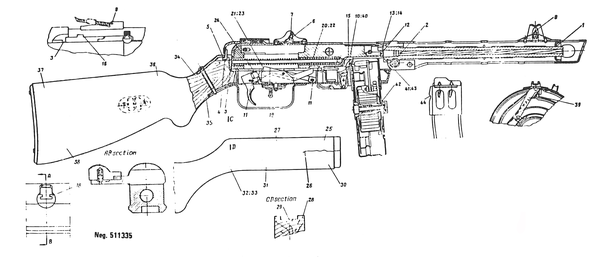
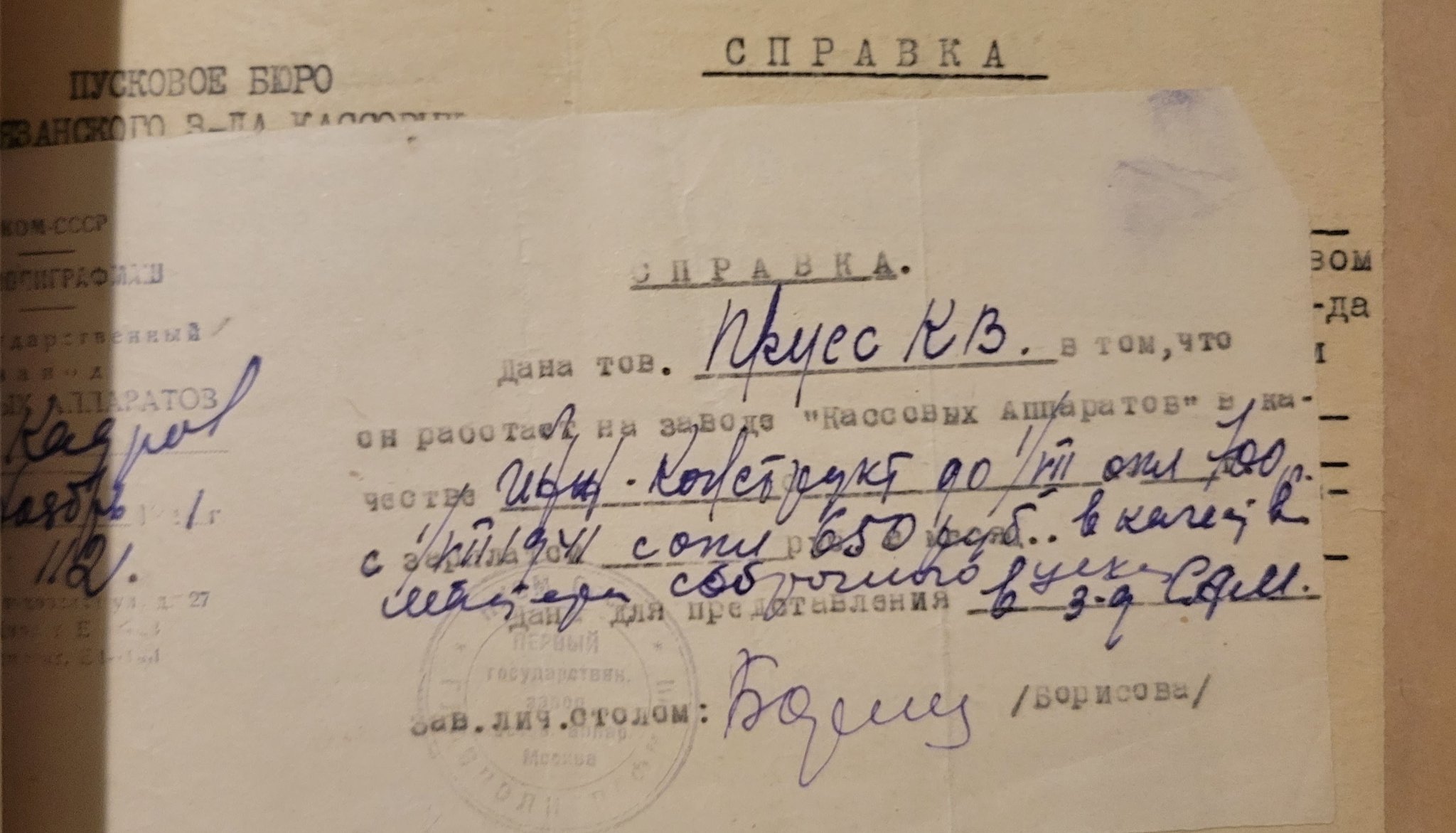
Karl Pruss graduated from the "Moscow Tech", the prestigious Bauman University, from the Precision Mechanics Department organized a decade earlier by his own father. Before his execution, Wolf Pruss managed to build Russia's first watchmaking factories, to hire foreign specialists and to train their domestic replacements. The whole family worked across the giant country at these fledgling plants, which quickly turned into "watchmaking in the name only". The USSR was rapidly militarizing, and almost all the industries were dual-purpose civilian and military production centers. Time fuses, aviation instruments etc. were becoming the main output of the watchmaking factories, and Wolf Pruss's Precision Mechanics Trust was folded into the munitions administration of the People's Commissariat of Heavy Industries. Everything was now defense and classified. Karl's Master's Thesis was on a new design of a recording chronograph, and he seemed destined for military-industrial work. 

But the calculus changed when, at 26, he suddenly became a son and a brother of the condemned enemies of the people. With the top-clearance jobs now out of reach, Karl settled for a far less glorious engineering position at SAM, a factory manufacturing mechanical calculators and typewriters. When the Wehrmacht invaded Russia, he was on a launch team of a mechanical cash register production. These decidedly civilian products were being hurriedly replaced by war materiel, and by August 1941, less than two months after the invasion started, SAM started making submachine guns on a trial basis. By then the Germans had already advanced over 300 miles. Karl's aunts and cousins in Belarus were trapped behind the German lines; none will survive the war. Hundreds thousand draft-ineligible men from Moscow were sent to People's Militia divisions to man an additional line of defense around Moscow, just in case the Germans break through. Karl was ordered to keep his job, now deemed too important for the defense effort. 


The German breakthrough came in late September. By October 7, both Red Army's forces of the main defense line and the poorly equipped Militia at the 2nd line were encircled. Moscow was just over 100 miles away, with hardly any Red troops left to stop the onslaught. A motley collection of cadets and police forces tried their best to slow down the German war machine, but on October 15 Stalin made a decision to prepare Moscow to surrender. The government, the factories, the research centers were ordered to be relocated East the following day, October 16th, known as Moscow's Black Day. Only Stalin himself and his closest minions, as well as production factories of immediate relevance to the front, were to stay. On the morning of the 16th, the city was in chaos, enveloped by smoke and soot of the burning archives. The subway and the street cars didn't run. People lined up at the factory offices to receive their last pay. Looting started, and the leaflets calling for a pogrom appeared. 

Karl's wife, then a grad student, received an order to relocate with her school. By the end of the day, she was with her 1 year old son, my father, in a cattle car of a freight train slowly going East. Karl's SAM factory also received an order to relocate. But not him. The troops on the outskirts of Moscow needed every gun they could get right now, and wouldn't allow the production to be shut even for a few weeks for relocation. The submachine guns were being sent to the front literally as they were being assembled. The logic of the moment was that even if the production line and its workers become a total less with the expected fall of the city in two or three weeks, the guns they produce in the meantime would justify the loss. 

Then, a miracle happened. Two days after the Black Day, the fall season arrived in force with torrential rains, turning Russian roads into rivers of mud. By the time the mud froze in two more weeks, the Russians brought in enough reinforcements to save their capital city. And SAM's production, now called Factory #828 of People's Commissariat of Mortar Munitions, started expanding, gradually filling the other buildings left behind by the relocated factory, and then into the buildings of adjacent factories. It was manned by 14, 15 years old boys and by women. The PPSh was a cutting-edge model, just commissioned a year earlier, and the whole 1941 production at all sites amounted to 90 thousand guns. But with the scale-up, they soon made more of these guns in one months. The old SAM remained a bit player. At the height of the production, the 828th was churning out 5,000 guns a month. 

But Karl Pruss was stuck at the 828th for 3 more years, all this time resenting the fact that his unique watchmaking engineering skills were being squandered for something as technologically primitive as the PPSh guns. Only in 1944 the factory finally allowed him a job transfer to the National Time Synchronization Service.

And the factory? It shifted into digital calculators, and eventually, into all sorts of military electronic equipment. But it kept on shrinking in the post-Soviet times, and its best buildings are occupied by restaurants and boutiques now. And one venerable tango venue, too.

It may be hard to even conceptualize the role of tango in today's Russia, amidst all the mushrooming hate and the unending war. It is first and foremost an escape, an illusory world away from the daily horrors, a way to keep on pretending that life is whole, unbroken. I needed its embraces for this escape and this illusion, for my sanity. It's a good, positive role in many ways. But it isn't guilt-free, not at all. The government also wants its sheeple to be contented in the same illusion of unbroken life. There are endless celebrations, festivals and talent shows in town, a veritable Feast in the Times of Plague. And tango, perhaps unwittingly, plays along. Perhaps a milonga is more of a simple act of spiritual healing, but what about the performances and the festivals which still go on? Almost all of the showcased talents are local now, but occasional Argentines, like Alejandra Mantignan, come to teach and perform, too, and I find it extremely objectionable. And then, there is no escape from the horrors of the outside world even in the cloistered space of a milonga. People aren't always silent. And they don't always limit their talk to the music and the steps. I haven't heard anything full-bore militantly patriotic; it looks like almost everyone fears the war or hates it. But it isn't so simple. There is a lot of xenophobia directed at the Ukrainians and the West in general, a lot of regime-fanned grievances. They did this to us, they did that to us, we didn't deserve any of it kind of stuff. There is a widespread belief that the Russian forces behave impeccably, never target any civilians, that all the war crimes are either fakes or false-flag operations by the Ukrainians themselves. Occasionally people open out and whisper how they hate Putin, but even then, it's all someone else's fault, not Russia's. I mean, in America we sort of tiptoe around conspiracies and crazy beliefs, be it about politics, vaccines, or some other health and wellness issue. It's happening outside of the ronda, especially in the social networks, and it slowly poisons our pure world of dance and music from the outside, but sometimes it invades the milonga halls too. It's something similar in Russia, but more crude, more powerful, and more dangerous there. A simple careless word gives you years in prison, and if it is found to indirectly contribute to Western sanctions, then it's life in prison. How much worse is it going to get before it gets better?


Tuesday, October 25, 2016

BC Tango music class notes ... and a memory detour to Moscow

Salt Lake's art nouveau Ladies Literary Club (now The Clubhouse at 850 E. South Temple) used to be the cradle of the "dance tea parties" (the dansante) of the heyday of pre-WWI American tango boom, and it's amazing to witness its rebirth as a tango venue a century later. And it's especially poignant that the first tango workshop in this grand hall focused on the history of tango!

Tango BC is a contemporary tango duet (Mariano Barreiro, piano, and Santiago Cursach, guitar).
But they don't just play music - they teach how to interpret tango. Their class started with a history lecture, dividing the story of the tango music into 4 chapters:

Tango BC duo
1880 - 1925: Guardia Vieja (exemplified by Villoldo, Arolas, Canaro, Matos Rodriguez....)
1925 - 1955: Guardia Nueva (such as De Caro, D'Arienzo, Di Sarli, Pugliese)
1955-1975: Avant Garde (Piazzolla, Salgán)
1975 + : Contemporary Tango (Fernandez Fierro, El Arranque, Ramiro Gallo - and of course Tango BC themselves)

Guardia Vieja (Old Guard) musicians were almost all amateurs. Europe and Africa influenced the emerging synthesis of different musical forms: Congolese and Angolan candombe, Afro-Cuban and European fusion of habanera, and Argentine hinterland's milonga campera. The fusion of milonga and candombe existed in its own right - listen to Azabache! Mariano and Santiago play examples of the three ancestors of tango, asking the listeners to identify what flowed into the future tango from each of these genres.

Here I must tell you that Bizet's Habanera holds a very special place in my musical education and, perhaps, in my path to tango. We must go back in time to the 1970s Moscow for this story, but before we get there, let me mention that the Habanera from Carmen wasn't actually created by Georges Bizet. He may have thought that it was a folk song but he soon realized that the tune has been composed 12 years earlier by Sebastián Yradier, a native of Spain's Rioja region, who also composed the other most famous habanera of all times - "La Paloma" (Yes, the songs which brought worldwide fame to Cuban music were composed by a Basque who haven't even visited Cuba until the age of 50!)

Kropotkinskaya station.
Wikipedia image
Yet for me, Carmen's Habanera evokes neither Spain nor steamy Cuba, but snowbound old town Moscow. More specifically, my grandfather's traditional walking path to the Moscow Conservatory. Gramps Karl (or Charles, as grandma preferred to call him in French) was a semi-amateur orchestra clarinet player. Everyone in his family was a part-time musician or singer or actor, but his older brother, violinist Isaac, has been executed in Stalin's purges along with their father; and soon after, they lost the sisters' piano as well. Grandfather Karl was the lone musician survivor now. His children didn't share his passion about music, and now he was hopeful to get me, his first grandchild, into it. Karl bought an educational concert series at the famed Conservatory for the two of us -  up at the balcony overhanging right above the orchestra. Soon, I was able to name every instrument - alas, visually, rather than by ear :) Honestly, I didn't like these concerts at all! But I keep the fondest memories of our walks together. Grandfather lived an exotic life, having grown up in Switzerland, picking his first Russian only after high school, moonlighting as a translator for foreign dignitaries for a while - and then, after his family was decimated by the bloody purges, he was kicked out of grad school, worked on river boats and nearly perished in a floating crane disaster, and then it was his turn to be sent to the labor camps and his luck to come back alive ... not all of the stories were safe to share, but out of the ear of the fearful grandmother, he had some amazing stuff to tell. 

We'd start at Kropotkinskaya Metro Station, one of the most beautiful in Moscow, built in the early 1930s to serve the giant House of Soviets which has never been completed. So the huge, airy subway ended up being far too big for its modest neighborhood, and eerily more beautiful because of it. The steel frame of the unfinished palace has been cut into anti-tank obstacles when the Nazi troops advanced to the outskirts of the city in 1941, and the remaining giant hole in the ground eventually made way for an outsize open-air swimming pool, open year round. Karl would occasionally take me there in the middle of Moscow's long winter, too. 
Chess playing at Gogolevsky Boulevard remains a Moscow tradition
We'd walk up Gogol Boulevard, where the chess players would converge at street tables outside of the Central Chess Club to play, no matter the freezing cold. We'd cross Arbat and dive into the maze of lanes of the former Royal Fermenters' Borough where the artisans once prepared sauerkraut, pickles, and kvas (fermented malted rye bread drink) for the Czar's palace. There, hidden away from the main streets, stood in obscurity the first Soviet skyscraper, the Mosselprom Tower, all 10 stories tall, still sporting the faded ads from pre-Stalin's years, complete with the mural of the Horn of Plenty dispensing such indispensable products as cheap smokes and caramel candy. (Its namesake, Mosselprom, was the 1920s agricultural product processing and trading conglomerate). And finally, we'd round a corner and there would be the gilded edifice of the Conservatory! Our weekend walks continued until I finally heard a musical piece I loved. Alas, it was the Habanera from Carmen.

"You can't get yeast and papirosi (the cheapo smokes
once popular with the Russians and  evenpreserved in a
 tango name, Elegante papirusa) anywhere
but in MOSSELPROM!"
I'm afraid my admission broke my grandfather's heart. He was, like, all is lost, you'll never get to love the classical music, you're obviously destined to like rock and stuff :( But in hindsight, perhaps it wasn't an omen about rock music, after all. Perhaps it was all about my future infatuation with tango?

Back to Tango BC's workshop now. More musical influences came from the European dance beats - note that almost all early tango composers came from Europe themselves or were born to recent European immigrants. The earliest bands had just 3 instruments - guitar, flute, and violin. Bandoneon comes from Germany later, following a more humble concertina. Bandoneon has a unique ability to modulate the intensity of its sound on the same note, adding a great expressive potential to the bands. But tango has already been well established, and bandoneon "invaded" it against the wave of initial rejection - and changed tango!
Piano "invades" around the same time, and professionally trained musicians and larger bands come in.
The Old Guard music started out rigidly structured. Julio De Caro worked to break the stereotypes. Rhythms acquired syncopation instead of uniformity of the regular "marcato" beat of the Old Guard. Where all the instruments used to play together, now emerged a great room for individual expression of different musicians. The New Guard times have become known as the Golden Age of tango, when its music sounded everywhere!

Santiago and Mariano then introduce us to the Argentine terms for the 3 principal beat patterns of tango, and illustrate walking to the 3 beats by playing :Por una cabeza" with varied and variable accents: the main beat / "marcato", the "blancas" / "whites" of every other beat (so called in Spanish because the half-notes are notated by hollow ovals, "white inside", as opposed to filled-oval quarter-note "blacks"), and the unevenly spaced "sincopa"... plus "arrastre" / drag effects merging together the adjacent sounds of the sincopa, as in dragging one's palm over the guitar strings. It's a great workshop plan, to alternate between listening and practicing to the customized live music on the dance floor!

There was so much more in the workshop material which I couldn't cover in my notes ... from the fundamentals for those who just begin to discover tango to the discoveries which surprise and enlighten the most seasoned tangueros. Thumbs up, Tango BC!

Wednesday, December 10, 2014

A detour to the labyrinths of memory with Tango Elmira

For a recent long tango road trip, I got an mp3 disk full of Elmira's old "tangotales" podcasts, to listen to on the road. Surprisingly, one of the series, which she called a "detour from tango", brought me to my own childhood memories of Russia and inspired me to retake Elmira's detour through the mists of memory. Elmira traveled to Boston to listen to Yo-yo Ma's performance of Piazzolla's music, but the sound of cello evoked something else in her soul. A flashback. 
A scarlet sunset in St Petersburg, from Vladimir Kezling's travelogue
A beautiful memory of a late sunset in summer Leningrad, flooding the hallway of her childhood home with scarlet light just as she walked in to the sounds of wonderful music emanating from the family radio - the sounds which made her realize the inevitability and poignancy of death. She was 5 years and 10 month old, she says, which puts it to June or early July of 1970. She remembered that it was a weekly 9 pm show, named, she recalls, "A reunion with the lost song". This memorable cello piece was the musical intro for the program, so young Elmira got to listen to it again and again - until they were separated by emigration - but never learned what it was. Only years later, a chance reunited her with her childhood memory, when she recognized that the music was the opening bars of Heitor Villa-Lobos's aria from Brasileira Bachiana Number 5, with its pizzicato and a wordless female voice. The memory of Bachiana got forever sealed with the sound of cello in her mind.


As I listened, I was having flashbacks to another room in Russia of our childhood, where the last twilight of a late-summer evening still made discernible the contours of my late grandfather's "spoils-of-war" German tapestry above the bed, and where radio played in the dark - yes, one can translate the show's name as "A reunion with the song" - but, wait a second, there was no cello in my memory. No way. No Bach allusions. The musical intro of my memory was folksy, back street village folksy ... and I even thought that the instrument was Russia's folk garmon, a type of a button accordion (pictured here on the right)
And then another detail didn't add up either - the dusk glowing scarlet at 9 pm. We are fell in love with the famous St Petersburg White Nights before. These are the nights of Summer Solstice, when the Sun doesn't even go down until after 11 pm, and the sky is ablaze with colors literally all short night long. As Pushkin famously wrote in the Bronze Horseman, the night is reduced to a mere half an hour.

А.С. Пушкин. Медный Всадник.    

...И ясны спящие громады
Пустынных улиц, и светла
Адмиралтейская игла,
И, не пуская тьму ночную
На золотые небеса,
Одна заря сменить другую
Спешит, дав ночи полчаса.

John Dewey transl., 1998

...Deserted streets huge buildings clearly 
Loom up, asleep; and solar fire 
Plays on the Admiralty spire; 
And Dusk directly (as if plotting 
To keep the golden skies alight) 
Hands on the torch to Dawn, allotting 
A brief half-hour to cheated Night.

The map of St. Petersburg in literary quotes,
by Yury Gordon. The Bronze Horseman verse
(highlighted) marks the location of the Admiralty.
So I had to check what people recall of that radio show my grandma used to listen in bed. It was a show people wrote letters to, imploring its omniscient host Victor Tatarsky to reconnect them with the songs of their memories, to the songs which perhaps never even existed on vinyl, the songs about which they often remembered preciously little. But it was always leading to the happy end - from a poignant life story from a listener's letter, through a hard-to-crack riddle of memory - suddenly, to the solution: the song they missed. The show was called "Встреча с песней" in Russian, literally "Get-together with song". And the musical intro was indeed an accordion record of the classic 1947 "Lonely Garmon". (It's a lot better known in the West as Yves Montand's "Joli Mai"). The clip below has Sergey Lemeshev's rendition, the one used in the radio show. The verse actually predates the song by a couple of years, and it used to be longer and more sad, too.


Одинокая гармонь
Михаил Исаковский, 1945

Снова замерло все до рассвета,
Дверь не скрипнет, не вспыхнет огонь.  
Только слышно на улице где-то
Одинокая бродит гармонь

То пойдет на поля за ворота,
То вернется обратно опять,
Словно ищет в потемках кого-то
И не может никак отыскать.

Веет с поля ночная прохлада,
С яблонь цвет облетает густой.
Ты признайся, кого тебе надо,
Ты скажи, гармонист молодой.

Может, радость твоя недалеко,
Да не знает, ее ли ты ждешь...
Что ж ты бродишь всю ночь одиноко,
Что ж ты девушкам спать не даешь.

The Lonely Accordion
Mikhail Lisovich, (with my extensive replacements)

Once again all is still until morning
Doors won't creak, not a fire alight
Yet alone in its soulful intoning,
An accordion roams in the night

Now wanders afield, to the meadows,
Then once more to the village returns
As if searching in vain in the shadows
Still unable to find whom it yearns

Gentle breeze of the night cools the air
Petals flutter from orchards in bloom
Who is she that you call in despair
Who can cure accordion's gloom?

Speak to her, let your secret be known,
She is here, your joy, your heart ache!
Don't wander at night all alone,
Keeping girls in the village awake!

But where does Bachiana Brasileira fit into this? The connecting dots seem to go like this: 

Victor Tatarsky, the host of my granny's radio shows also ran a succession of national radio shows for the younger listeners. They tended to be short-lived, often nixed after someone would complain that the programs paid to much attention to the popular Western music. One of the best known Tatarsky's "young" programs, "Record this to your Magnetophon" ("Запишите на ваш магнитофон"), started in December 1970 and featured foreign records unavailable in the USSR - say the Beatles if you can believe it - and its musical signature tune was, unbelievably, a rock music clip! (from "Ten Years After", a British group). Eventually the "Magnetophon" was shut down, of course - only to reemerge under a different name, and to inspire regional copycats. 

this looks like a cable radio set
we had at our place, where
my little sister listened to
"edutainment" programs and
musical fairy tales, sometimes
irritating her book-loving
brother so much that once
I cut the cable with scissors
(and then I had to patch
it up myself, having quickly
discovered that girls tears
are even more distracting
than their fav radio shows :) ) 
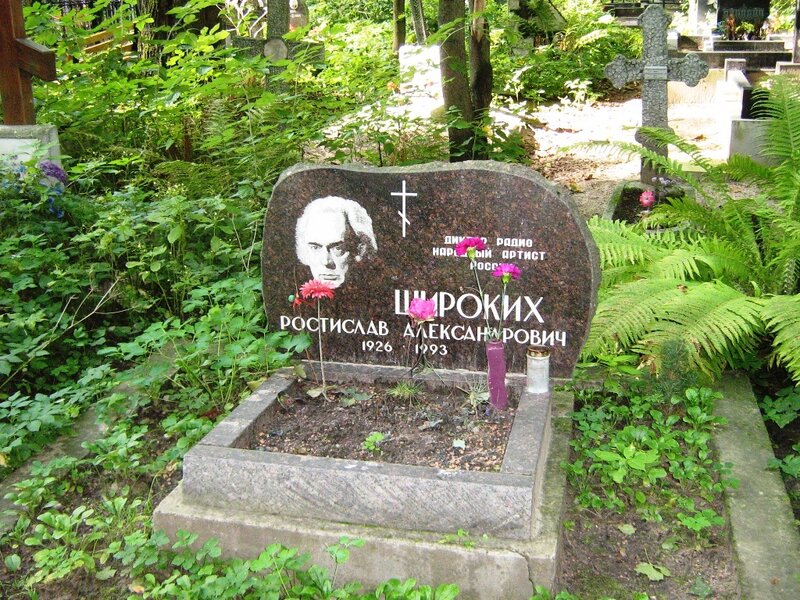
It turns out that in Leningrad, the post-Tatarsky's Magnetophon radio program was called "Your Tape Recorder" ("Ваш магнитофон"). Hosted by the local radio celeb, Rostislav Shirokikh, it featured whole albums of foreign groups, in 45-50 minutes segments. The show was truly geared to being tape-recorded, complete with a countdown to the "Action!" command, and "Cut!" in the end. "Your Tape Recorder" aired at 11:10 or 11:15 pm on weekends, starting in 1976 - and it was also available on cable radio (yes, wireless radio was kind of discouraged in the old country, and banned outright during WWII, lest the listeners tune it to BBC or some such unapproved station, but starting from the 1920s, all Soviet homes were wired for the cable radio broadcast, and in most city flats, the radio was on all the time in the hallways. The oldtimers still remembered the times when it was considered an unpatriotic offense to switch off this stream of audio propaganda). And its signature musical intro of "Your Tape Recorder" was ...  Brasileira Bachiana #5!

Rostislav Shirokikh grave,
at a leafy St. Petersburg cemetery
So it all falls in place, the time of the night (right after 11 pm), the place (a city flat hallway), the light, the sound ... only the age of the narrator doesn't fit. Elmira must have been at least 11!