Showing posts with label tango capitals. Show all posts

Sunday, December 25, 2016

Tango, mankind's most unusual heritage

A UNESCO image
Tango is an element of the intangible cultural heritage of the humanity. On October 2, 2009 UNESCO famously called for its preservation.What most of us don't know is how special is Tango's place on the Representative List of the Intangible Cultural Heritage of Humanity. 

The goal is to safeguard living traditions in the communities: UNESCO inscribes local cultural practices and traditions on the List of the Intangible Cultural Heritage of Humanity to give them better visibility, to boost self-esteem of the local communities, to foster the global dialogue and to encourage the authorities to do more to safeguard them.The UNESCO process takes special care to avoid excessive commercialization of culture for tourism and for export. UNESCO's goal is for the cultural riches to remain vested in the community, transmitted from generation to generation in the natural way, and continuously developing with the flow of time; it strongly opposes the danger of "folklorisation"(where a quest for "strict authenticity" smothers natural evolution and transmission of culture). UNESCO clearly recognizes the clash between safeguarding cultural traditions vs. protecting copyright or ownership. Verbatim: "Indeed, as intangible cultural heritage evolves thanks to its continuous recreation by the communities and groups that bear and practice it, protecting a specific manifestation like the performance of a dance, the recorded interpretation of a song or the patented use of a medicinal plant may lead to freezing this intangible cultural heritage and hinder its natural evolution. Moreover, as the communities are the ones who create, maintain and transmit intangible cultural heritage, it is difficult to determine the collective owner of such heritage."
Argentine legislators joining the 2008 petition

The "where" and the "how".... The UNESCO process begins from defining the geographic range of the cultural practice, and its traditional mode of transmission (family, teacher-apprentice, observation and imitation?). Tango's "where" and "how" are unparalleled in the Representative List! It's geographic range is defined as the entire world - then the declaration seeks to safeguard tango's place of birth in Montevideo and Buenos Aires. There isn't any other musical / poetic / dance art form in the whole list which is defined as distributed world-wide yet needs safeguarding in its birthplace. With tango, much credit should be given to the global communities for making Buenos Aires a place of pilgrimage, a center of study, and a source of inspiration. That's why a globalized cultural phenomenon was able to revitalize its cradle. Time and time again, when tango was in danger at its place of birth, the expat communities lent hand to sustain it ... as early in the 1900s, when tango was disallowed by the Catholic Church itself, and derided as an African-influenced, underclass subculture by the purists at home, and then in the "dark days" of tango in the 1960s and 1970s, when the foreign music fans didn't let the tradition lapse, and of course beginning in the 1990s with the social dance wave going global.
With the traditional mode of transmission, tango is just as unique. UNESCO simply refused to narrow it down to something specific. So tango has become the only cultural legacy which has lots of "right ways" to pass on the tradition!
UNESCO asks, then, about a nominated cultural practice: How does it adapt to modernity? Are the traditional ways endangered? Are there urgent safekeeping needs? Any cultural asset worth being protected by UNESCO must conform to the human rights. Importantly, sacred practices and oral arts may be safeguarded, but neither religions nor languages themselves qualify for protection. In these respects, tango isn't totally unique, but it's still very special.  Verbatim: 
- tango both embodies and encourages diversity and cultural dialogue
- it adapts to new environments and changing times
The UNESCO declaration makes it an honorable duty of Argentina to nurture its tango community in BsAs, while strongly speaking against exclusive "ownership of culture", and for broad global dialogue, change, and diversity."Inscription of the element on the Representative List would contribute to visibility of intangible cultural heritage and a deeper understanding of the Tango as a regional expression resulting from the fusion of several cultures" 

The petitioners: The UNESCO declaration was sought jointly by the municipalities of Buenos Aires and Montevideo. In Buenos Aires, Luciana Blasco, a cultural event organizer who then served on the city council, spearheaded the petition, citing the existing 1998 City Law 130 which already called for the city to help its tango community. Such luminaries as Horacio Arturo Ferrer (1933-2014), an Uruguayan-Argentine tango poet of "Balada para un loco" fame and the creator of Argentine National Tango Academy, Leopoldo Federico (1927-2014), bandoneonist of such classic orchestras as Di Sarli and Troilo's, composer, and tango orchestra leader, Raul Lavie, a contemporary tango singer, José Gobello (1919-2013), the patriarch lunfardo expert, and Laura, second wife of Astor Piazzolla and chairwoman of his memorial foundation, joined. Such famed dancers as Mora Godoy and Miguel Angel Zotto supported the project (Mora, who describes herself as the most important tango dancer in Argentina, once famously dragged reluctant Pres. Obama onto the dance floor). Zotto, who already starred in Tango Agentino on the Broadway in the mid-1980, famously said that nothing endangers tango in today's global culture. We see a broad list of tango innovators and modernizers signing up for a project to preserve the heritage, but it should come as no surprise, being one of those contradictions which are always woven into the fabric of tangoInterestingly also, among the preexisting conservation efforts, they also listed both Day of Tango, December 11, and the virtually unknown Uruguayan Day of Tango, October 5 (this date commemorated the creation of FUTANGO (Federation of Uruguayan Tango) in 2005, but it kind of dissolved in the broader festivities of Uruguayan Heritage Days, and never really caught on). 


So many facets! The petition strongly emphasized cultural diversity as the very core of tango, a central part of its essence and roots, and its continuous development in cross-cultural fertilization. There were many cool details in the petition which which didn't make the cut in the UNESCO declaration. For example, in addition to tango proper, milonga, and "so called vals criollo", the petition sought to include the sub-genre of the milonga candombeada, too. In addition to musicians, poets, and dancers, the petition originally sought to include playwrights, script writers, historians, journalists, editors, website operators etc. Language of tango was petitioned for (since Lunfardo Academy was one of the movers behind the project), but UNESCO rules specifically disallow as broad things as language from the lists of cultural heritage.The petition also sought to include tango-related handicrafts (later on, filete won a separate UNESCO heritage designation). I can only assume that the broad scope of the proposed protections was eventually found to be too wide for the UNESCO process, which is more geared towards community artists and craftsmen than to the big-city editors, producers, and web designers

Superficial foreign fans and enforced authenticity? Another sentiment which didn't make the cut was a kind of a familiar lament about shallow understanding of the tango culture abroad. The petitioners suggested, in particular, that "the Europeans understand Tango as music of the belle-époque", with exaggerated sensuality of a luxury cabaret, and don't appreciate tango's humble, underclass roots. ( Irony mode on - to see tango with all these supposed sins of exaggerated sensuality, with the woman thrown around exactly as the petition complained, one doesn't have to go any further than the cool promotional clip of one of its most famous signatories, Mora Godoy! :) ) 

Of course this kind of a broad-brush cultural suspicion didn't fly, and the UNESCO declaration carefully avoided blaming the "superficial foreigners" or calling for "proper authenticity". But one has to understand that it's so common for the locals to start fearing loss of identity just as their cultural heritage finally gains appreciation and popularity abroad. More on it below... 

Pledges and failures: The petitioners pledged to spend hundreds thousand dollars to support tango life in BsAs and Montevideo, including promoting historical venues, creating tango hostels for visiting trainees, a huge documentation and record center, an institute and a fund to support milongas ... even half a million dollars to establish a tango museum in Montevideo! But hardly anything has been delivered. When, in 2013, the governments reported on its progress, they had just one modest achievement to brag about, a newly organized Tango Research Center in Argentina. As we know, many traditional milongas in BsAs (both indoor and outdoor) are under a persistent bureaucratic attack, losing venues completely, experiencing temporary closures. The cradle of tango needs protection, and the UNESCO declaration continues to require action.

Is this a right way to balance the aspirations of the global vs. indigenous communities? The Convention on the Intangible Cultural Heritage is only 13 years old, although it has been informed by UNESCO's decades of cultural protection and community development experience. Its pros and cons have been recently reviewed by Farah and Tremolada (2014). The core issue is familiar to us, tango lovers: it is the issue of indigenous control of cultural heritage vs. globalized identity drawing from a variety of cross-fertilizing cultures. The global community may fear being robbed of its means of expression, while the indigenous community may fear an identity crisis.
Prof. Farah lectures on legal frameworks
of safeguarding cultural legacy

Intellectual property (IP) models, especially copyright, are also widely used for cultural assets. Importantly, copyright protects the asset only over the defined period of time; then it falls into public domain for all to use. IP protection is also narrowly focused on money rather than on community values / sacred values. IP = fair exchange of cultural assets for commercial value, at the expense of freedom of expression. SADAIC and AGADU have long followed the IP copyright model for aspects of tango culture, and tango music and poetry did become a commodity, which has also become targeted for export very early on. Because of this commodification and the global market focus, an alternative IP protection tool of "geographic indication", has become impossible to apply to the tango culture. 

But, as UNESCO uderscores, living cultural tradition isn't a mere reproduction or copying. It includes creativity and innovation and this makes it even harder to apply IP framework. Safeguarding cultural heritage is likewise more complicated than mere protection. It also includes an obligation to let the cultural practices develop and evolve in a continuous process of social involvement.

In 1982, World IP organization and UNESCO already tried drafting a new framework for national laws for regulating folklore (potentially including bans on fusion forms or distorted forms of traditional culture). In this framework, wherever money was at stake, practicing folklore would have required a license from the government. This idea was fundamentally at odds with the freedom of expression, and the proposal didn't go anywhere. But the experience of drafting the failed, overreaching model framework was seminal for UNESCO's subsequent fine-tuned efforts to safeguard cultural heritage of the humanity. As a result, UNESCO defined indigenous cultural heritage as a living, evolving form of expression practiced by the communities, rather than rigidly codified by the governments.

Wednesday, December 25, 2013

Prague Tango Alchemie, Summer Solstice 2013

Praha! To chutná jak hlt vína,
Opakuji si stokráte


Prague’s heady like a gulp of wine,
I keep repeating and repeating

Jaroslav Seifert, “Wreath of Sonnets”

Argentine Tango is an art of mastering your own body and the body of your partner
to be able to compose a unique musical conversation on the dance floor.
MilaGrosa Vigdorova

6 Chapters of Magic:
White Night
Red Night
Celestial Night
No longer Black Night
Grobovka Vineyards
The final Element
Tangueros of the world are a gypsy caravan-like community, or a secret society if you will – people who understand one another and communicate without words, relying solely on the language of bodies and eyes, and who sometimes struggle to remember foreign-sounding names of their dance partners with whom they just shared a tanda, the proverbial 15 minutes of motion, music, and heart-to-heart connection.

Viviremos los dos el cuarto de hora
de la danza nostálgica y maligna


Let’s live together, the two of us, for a quarter of an hour
Of this evil and nostalgic dance
Claudio Frollo, “Danza Maligna”

It is a rite and religion, goes on the verse. And we have no doubt about it. Throughout the year, across the globe, tangueros of all languages and ages gather in large halls of tango festivals and marathons to mingle together and to dance their fill.
Some are locals, some travel hundreds kilometers, and a few, like us, cross continents and oceans

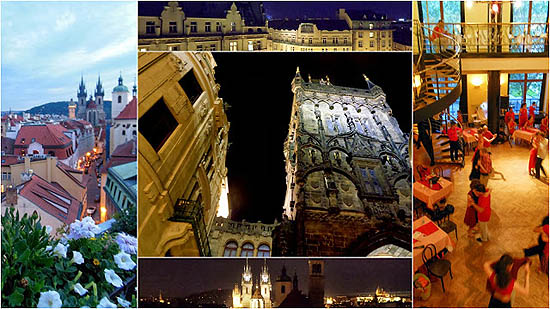
Solstice Magic of Prague


Prague Tango Alchemie festival is a relative newcomer to the Old Continent’s Argentine Tango scene (where some tango meet-ups date back to the very early years of Argentine Tango revival world-wide, like the festival in Sitges, Catalonia, or the tango camp in Nijmengen, the Netherlands, which boast a 20-year history).
The Alchemie has been running since 2007, but it already build a worldwide reputation for magic and splendor.
The milonga balls are styled after Elements and astrological Symbols, the venues are a succession of ever-more-stunning historic palaces, and the performances are something special, a fusion of tango and elemental symbolism.
And … it is the beautiful Prague, where the magic of ages is palpable – and nowadays, supplemented by a Vegas undertone of a Sin City which Never Sleeps (to a degree, Prague is to Germany what Vegas is to California, a strange city a short distance away, where the rules fade and where laissez-faire rules.

Alchemie 2013 started from a few disappointments … some of the gala milongas were scheduled to be in a beautiful but very modern shopping center at the edge of the Old Town; and then, flood damage took the Red Chateau (Trojsky Zamek) off the venue list; so the Red Gala Milonga would have to be in the same Slovansky Dum as well. But then the organizers added open-air street events to the mix - so we get a chance not just to see Prague, but also to show the city what we dance. And since there will be tango until 7 in the morning almost every night, we won't even have to switch to the European time zone; the plan is to sleep by the day, dance by the night.

White Night of the Moon

White Gala photo by Kristin Bjarnadottir

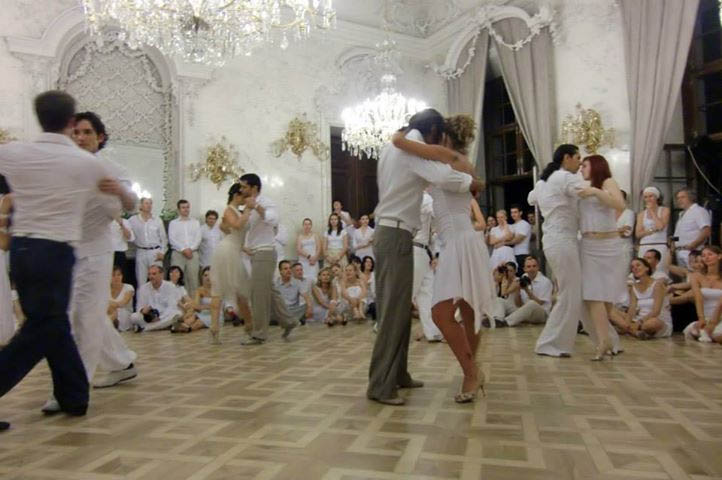
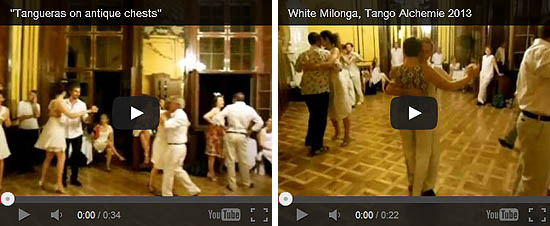
Clam Gallas Palace, an early XVIII c baroque edifice in Old Town which once saw grand balls with Mozart himself, and was more recently used to house city archives, is all splendor of white and gold. No wonder that it’s traditionally used by Tango Alchemie for the White Milonga. An enfilade of ornate halls leads to the main ballroom – but the white-clad tangeros are dancing in every room, big and small! And one of the first dancers to greet is Balbeska, a long-time virtual acquaintance who first introduced me to Poemas del río Wang, and whose poetic Prague travelogue of 2012 prompted us to go to Alchemie-2013. So nice to meet you in realspace at last!


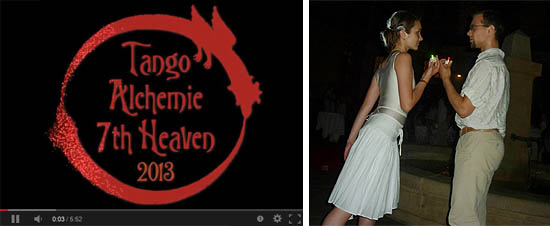
At midnight, in the fountain courtyard of the Palace, the tangueros greet the change of Zodiac signs with a magic dance of lights of La Brujeria of St. Petersburg, Russia, which culminates when the candles pass from the hands of the dancers into the hands of their bewitched spectators who then join in and pass on the light – and when the music is finally over, all of us return upstairs for more tango and chat with new friends.


Red Night of the Sun

In 2013, the rest of the Gala Balls of the Alchemie got shifted to “daytime hours” – they were over by 9 in the evening, unfashionably early for the dyed-in-the-wool tangueros like us. So we usually showed up just for the last hour or two. But it was only the beginning of the night when you could keep on dancing until after sunrise. Before the Gala Milonga, there was, at last, a chance to dance on the streets of Prague, and to live bandoneon music of Maximiliano (the city’s resident street bandoneonist) at that! We met “at the Horse at Venceslaus Square” – the one which is standing upright near the National Museum, not the other horse which is suspended upside down with Saint Venceslaus perched over its belly, inside a famous pub just down the square.

The Red Night program included a walking-and-dancing tour of the Old Town which got quietly canceled and replaced by a rooftop reception and milonga at the Terrasa at Namesti Respubliki. In a typical chaotic Prague fashion, nobody quite knew the whole story, but still, soon we made our way to this beautiful perch overlooking the whole city, got drinks and gave up on getting food in this scenic but totally overwhelmed establishment, danced a few tandas and went home for a little rest before returning to Slovansky Dum to dance some more, till dawn.


Celestial Night of the Stars

The street dance of the day was supposed to happen at Mustek, “Little Bridge” which once stood over the moat separating Old and New Towns, but at the last moment it was shifted over to Uhelny Trh, a more intimate square just a block away (laissez-fair is how things work in Prague – and with unexpected baskets of strawberries from the organizers this time!) There, Maximiliano’s bandoneon captivated attention of a passerby who happened to be an accordion and garmon collector from Russia, who until this moment didn’t have a clue that such a sister instrument exists. So in a break between dances, I ended up giving a detailed history lecture in Russian, how the German instrument-designer, Herr Band, named bandoneon after himself, how he marketed it for church services as an inexpensive organ replacement, and how, instead of churches, the bandoneon found its calling in the dockside pubs and bordellos of Buenos Aires, where its sound has become synonymous with the sound of tango.

The Celestial Milonga – colored mostly starry silver and gold rather than celestine blue – ended with an exuberant chacarera dance, a spirited folk dance which has become “almost” a part of the pantheon of the dance forms accepted at tango events (the classic trio of tango proper, swirly vals, and light-hearted nimble milongadance). Then the insatiable crowd filed to Jam Cafe just down the street, indeed jamming the tables and the little dance floor really tight.


Madeleine & Jorga in Jam Cafe, J.T. Jorg's photo
Compared to a slightly hyper-formal ambiance of the Gala, the sweaty crowd and patched-up floor at the Jam created just the right vibe for me. I best remember a sweet tanda which ended with Volnushka telling me, "You are crazy" ... here I must explain that the tango etiquette virtually prohibits a polite after-dance "thank you"; the "thanks" is a codeword for ultimate disapproval, for get-lost. So we tangueros must express our gratitude by any other words but never "gracias" - sometimes it happens to be ambiguous words - and so for the next 24 hours I was left wondering if I was crazy in a good or a bad way :)
The last tanda was over, but el gente (as the milonga-going public may be called) still lingered in the loft of the cafe, and then the DJ played a non-tango track, and the already-crazy scene turned truly deranged (and now I knew by heart whose glance I must try catching in a silent dance invitation rite of cabeceo next time!)

The party continued in Slovansky Dum, and it was already light when we finally left and walked the deserted lanes of Old Town to Tyn and Charles Bridge - stopping for some gyro at the only eatery open at this early hour, a Turkish stand operated by a Yerevan Armenian, eager to be complemented - in Russian - on the beauty of his hometown. But Prague, it's like a gulp of wine, its beauty would leave Paris in the dust! Have you ever walked Charles Bridge alone - without any crowds? Have you seen the slanted rays of rising Sun play under its XIV c. arches? But we now needed to get home for a bit of sleep!


at Hybernia Theater
The Black Milonga, of the Element Earth, used to be a part of Alchemie's tradition, but color black is already so overused in tango costumes, the organizers replaced it with a Pure Pleasure Gala, whatever colors you prefer. But first of all it was time for a street dance, this time at Hybernia Theater. Maximiliano the bandoneonist was nowhere in sight, and we danced a bit to Volnushka's keychain mp3 player, until an angel (as Alchemie volunteers are known) brought the word that the location changed again ... a sculptural installation was being unveiled at Charles Square, and the Alchemie organizers joined in for the event.

By the time we got to Charles Square, the scheduled dancing was almost over, but since everybody was late, Maximiliano played for another half an hour. Still it didn't feel like the right time to retire into the stolid atmosphere of Slovansky Dum, and we hatched a plan to walk towards the river and Charles Bridge, dancing along the way. Volnushka had the music, and I worked as a navigator (since our route traversed the very New Town neighborhood where we stayed, and which has already become familiar to me). We danced under a lone tree Na Struze, then walked into the courtyard of the National Theater where we found a Czech rock group finishing a gig - but they agreed to play some more after a brief beer break, and then we danced. Then to Vltava embankment and Children's Island Bridge, where we danced to a crooner of a riverside cafe (In the Pines, made known to the whole world by the Nirvana, yes).
at Charles Square
And on to Charles Bridge where we momentarily created a pedestrian traffic jam when we joined a blues band and doubled the crowd of spectators. That was sweet and very Earth-elemental, as in, having real ground underfoot. But it was, finally, time to retreat indoors, to Slovansky Dum and Jam Cafe again. It was a parting night of many last hugs, yet it didn't really feel like a final night for us because we still stayed in Prague for two more nights of dancing - and so did a few other festival-goers.
The Guerrilla tangueros at Charles Bridge


Rain clouds were gathering strength but I still managed to tour the Jewish Quarter before it started pouring.


Grobovka Pavillion, nested
in the vineyards of
Vinohrady overlooking
Prague

And we were heading all the way to Vinohrady (Vineyards neighborhood) for a long walk across the estate park of Grobovka to a beautiful Art Nouveau pavilion perched on a slope in the real vineyards. The rain was unrelenting, and we had to leave our street shoes at the doorstep so as not to bring moisture to the dance floor. The place felt truly surreal, suspended between the Earth and the low clouds beyond the veil of rain. And as we danced, our interconnected shadows danced on the ornate wooden ceiling of the pavilion, as in the Pasternak's verse coming alive.
На озарённый потолок
Ложились тени -
Сплетенья рук, сплетенья ног,
Судьбы сплетенья

Distorted shadows fell
Upon the lighted ceiling:
Shadows of crossed arms,of crossed legs-
Of crossed destiny.


On our last night in Prague, the rain stopped at last, and we walked across the river to Smichov to a basement tango pub called El Element - since we already danced four nights consecrated to the Four Elements of Alchemie, this surely must have been the Fifth. The Alchemie crowds mostly dissipated by now; but the dances were very good, and so were the conversations. La Cumparsita, the signature closing tune of a tango night, came almost too soon, and we kept walking along the deserted streets and talking until it was truly time for the last embraces. We're gonna dance in Budapest tomorrow!