Wednesday, September 25, 2019

TTVTTM and the flow of the final tandas

We the tango DJs don't have any doubts about beginning a milonga with back-to-back tango tandas, the initial two T's of the obligatory TTVTTM tanda sequence of the genres. And why doubt, why overthink the thing, if there are usually too few dancers on the floor at the beginning of a night anyway. The early birds of tango are a special minority in any case, and a DJ is supposed to build the energy flow which works for the majority.

But what about the ending of a milonga, the crescendo of the Cumparsita, the dimmed lights and the overpowering emotions of love and sadness? If you keep repeating TTVTTMs, wouldn't the randomness of added track times mean that sometimes, the scheduled end-time comes with a boisterous laughter of a milonga instead of some poignant tango? Nah, of course we wouldn't do THAT to our beloved dancers :) A DJ may do something, perhaps scrapping the out-of-place milonga tanda, or adding more tangos after it, that's more or less clear. The question is, what is it exactly that you do?

The reason why I started musing about it was very mathematical. I spotted an arithmetic error of sorts in my statistical/fun analysis of the BsAs set-lists. Back then, I calculated that an average milonga had 13 tango tandas and 2.6 milonga tandas, and I was like, hmm, the number of the milonga tandas is less that 13/4, so their flow is probably not a perfect TTVTTM ... they must be skipping or replacing a milonga tanda here and there.

Sheesh. Now I saw the numbers in a different light. 2.6 milonga tandas (or 2.7 vals tandas), on average, would mean that approximately 10.5 tango tandas took place in the regular TTVTTM groupings. To add up to 13 average tango tandas, one would need to add, on average, 2.5 more tandas of tango. And it occurred to me that it's exactly what's happening ... at the end of a night!

Melina Sedo, the Encuentro warrior and DJ
Is it "in the books" or just a commonsense thing? My first thought was, I couldn't have invented it, I must have read about the "best ways to end a tango night" somewhere. But the only "DJing manual" detailing proper selection of the last tandas I found was a super-micromanaging article by Melina Sedo (and I definitely haven't read it before!)

Melina writes: "The 2 or 3 last tandas are those especially determining the emotional state people leave the milonga in. The final tanda should be tango, not vals and never milonga." (Big-name DJs occasionally - rarely - do play valses at the end, and perhaps a slow and dreamy milonga campera may fit occasionally, when the mood is right).

Since I have a good collection of published playlists, I couldn't resist quantifying what *I* do.

It turned that my pre-Cumparsita tanda is always a tango. And in the majority of my playlists, at least 3 final tandas are tango (but I often play danceable music after the Cumparsita ... often energetic and upbeat music, since I picked the habit from Momo Smitt who explained that it was the  "furniture-moving music"). The numbers average at 2.5 final tango sets, perfectly paralleling the prediction from the BsAs statistics.

How many tango tandas before the Cumparsita?
I also tallied the orchestras I select for the final two tandas. I knew that Pugliese would be a winner, since his orchestra is so perfect for the crescendo build-up. And surely it was:

Pugliese 64 tandas (!) (and most of the lists without Pugliese in the final tandas had a Pugliese tanda right before them)
De Angelis 22 (mostly late instrumentals)
D'Arienzo 9 (mostly late instrumentals)
Racciatti 9 (mostly female vocals)
Donato 8 (mostly lyrical)
Laurenz 6
Demare, Canaro 5 tandas ea
Di Sarli 4
Calo, Rodriguez, Salamanca 2
Troilo, D'Agostino, Malerba, OTV, Biagi, Tanturi, Fresedo, Varela 1 tanda ea
Mixed ultimate and penultimate tandas - 11 incl Sassone, Firpo, late-era bands including Color Tango, Ojos de Tango, Fervor de BsAs,  Krebsian Orchestra, Nuevo Quinteto Real, as well as some of the above orchestras (this clearly defies Melina's advice to play only true-and-tried classic sets in the end...)

I can clearly see that I am biased against Di Sarli for the crescendo-building sets, and it's probably explained by my overexposure to late, dramatic Di Sarli's in my beginner classes. It's just hard to overcome the kryptonite "I'm a beginner all over again" vibe of this uncommonly elegant music. But as a cancer professional, I also find it hard not to see the specter of cancer in Di Sarli's perfect, late-period pieces. The Senior of Tango must have known that his pancreatic tumor doesn't leave him much time, and he was in a race against time to bring the rough, crude hits of his youth to an elegant perfection - an almost morbid perfection. Have you read Pushkin's "Exegi Monumentum"? "The monument I’ve built is not in chiseled stone"? For someone on the oncology field, it may be painful to sense. Forgive me.


Friday, September 20, 2019

Limitless musicality as a shared obsession :)

I've just discovered the new star of the tango blogosphere, a super sharp and eloquent Igor Zabuta of Ukraine. And couldn't help remembering one obsessively and mutually musical tanda at last years Connect, and translating a passage from one of Igor's beautiful posts. Photo credits to Kyle Asher

There are pairs who feel a kind of a split challenge to dance musically, come what may. They step onto the dance floor with a mission to express the music together. It takes a special respect to the music and a peculiar courage. It is so understandable ...  indeed, what could be more helpful for a great connection between people than a lucky overlap of their obsessions :)

Thursday, May 16, 2019

Tango Poetry: Past to Present. Missoula Spring Tango 2019.

I was very excited and a bit scared when the organizers of Missoula Spring Tango fest invited me to give a multimedia presentation on the lyrics of tango. I lectured on tango poetry before, but only in my native Russian, and always with the extensive use of metric-and-rhymed translations of tango into Russian. English language is a much harder medium for the metered poetry, and I only have one tango translation in English. So - uh oh -  the May 2019 poetry talk would have to get by without actually reciting verses! And with as much multimedia as possible, for the ease of understanding (the slides are available here and a partial live-streamed video of the 1.5 hour-long talk, here). What a nice opportunity to think more about my fav subject! It's a go! The summary of the presentation is below.


Tango Poetry:
Past to Present
"Explore self-expression in tango through song lyrics. During this multi-media lecture, travel through time beginning with sung poetry illustrating the universe of urban migrants during the Great Depression and their despairs and longs for bygone days. Learn how lyrical language is reborn with exuberance, threatened again by the censorship of the morality police, and finally reaches a beautiful synthesis at the zenith of the Golden age"


Born a song, always a song

Humble street origins: sailor’s taverns of the port… black neighborhoods … prostibulos

Neither the score nor the lyrics were written down

In fact even after the musical scores WERE written down, the lyrics remained unprinted … and largely unprintable

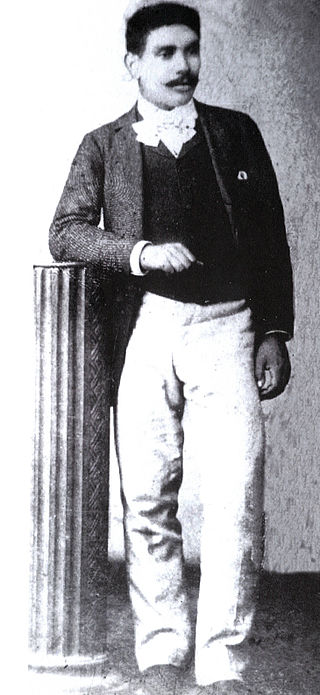
(on the right: the first known written musical score of a tango was composed in the 1880s by Rozendo Mendizabal, an Afro-Argentine pianist and a brothel musician. This tango, "El enterriano", is said to have been dedicated to an influential mobster from the province of Entre Rios)

The men and the women of the XIX c. tango lyrics


  • El Portenito  Little Porteño, a bragging song about the toughest and coolest dude on the block, with lyrics which once changed from street to street 
  • La Payanca
    A rare example of a "folk tango" which has known original lyrics, rather crudely and lewdly praising a popular whore
  • La Morocha A perfect feminine counterpart to the Little Porteño, also full of bragging superlatives about the sweetest and most beautiful girl on the block, and also not without a dose of double entendre like La Payanca

Payanca, the Kechua word...

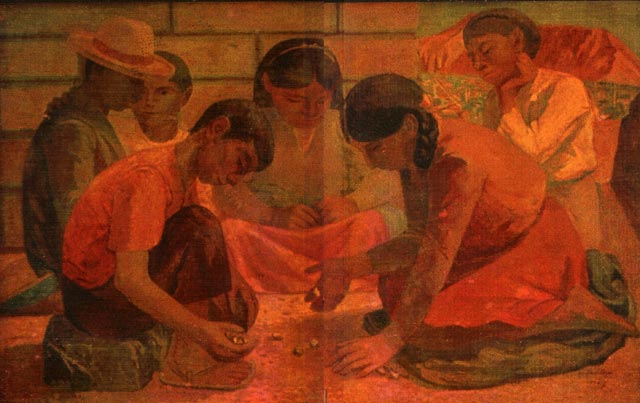
The tribal word from Peru - the verb pallar - meant to pick up, to catch from the ground. The gaucho equivalent of battle rap, the payada, was a real-time poetry contest where singers would pick up the thread of the song from each other, a stanza dueling with a stanza. The Kechua tic-tac-toe-like game, played with 5 stones thrown and picked from the ground (above), was called a payana. And a ground lasso, meant to be thrown to the ground to pick up an animal's front legs, was the payanca. This was also a street name of a legendary BsAs prostitute; who or what she picked up from the street, we can only guess, but there was a song dedicated to her, imploring her not to hurry with the paid-for job, because, well, sometimes slower is better.

Over time, La Payanca got very new, very clean lyrics. Actually, as the XX century arrived, the women stopped being protagonists for the new, cleansed tango lyrics. And the new character of the song was now a guy, an irresistible womanizer catching ladies with his "payanca of love". But much more recently, the genders of this song changed again, and the Payanca has become a girl like of old. Listen to Alex Krebs's gender-restored Payanca below, and read more about the song and about the  children's game on my old blog here


Apropos the last strong female protagonists of tango, I mentioned that it took full 50 years before they reappeared in tango - as in Donato Racciatti's "Gloria", a girl's song about love the money can't buy ... and I just had to jump ahead and to talk about the incomparable Tita Merello and her 1955 movie song "Se dice de mi", "They talk about me". How can one not to show Tita's superb clip? But do you know that she was singing a gender-transformed version of a song which was once written about a guy? Have you noticed that the girl in this song has manners of a compadrón, while the men in this song gossip like crazy and all lose their heads hoping for her affection? I hope that the, ahem, unusual gender stereotypes there all make sense now :)


The 1900s and 1910s: music of tango wins Argentina and world

  • Sheet piano music
  • Victrola records
  • Paris and New York Tango wins wide acceptance among the moneyed and educated classes, but strictly in its instrumental form
  • …. And where are the lyrics?? ... Shunned.


The revolution of Carlos Gardel, 1917. 


Tango receives its first set lyrics, written by a real poetic talent, Pascual Contursi. 

It was a sad song about broken love, which set the tango standards for the decades to come.

It was also a song written in heavy Lunfardo slang, whose protagonist seems to be a pimp, and whose love suffering is made more painful by the fact that his flat has become all dirty and cluttered now that his girl has left. The slangy opening lines may be translated as "The bitch who dumped me, just as I was having the grandest time of my life..."

Let's listen to Gardel's voice from a later recording ... and then to a much later recording where the long-dead Gardel sings the same opening line.


"A sad thought, danceable" ?

What else do the tangos sing about?


  • Quiz, anyone? Name other tango topics, beyond love / separation / romantic sadness
  • The legacy of “Mi noche triste”
  • A fragile macho needs some help...
  • Tango songs as a protective male cocoon? Sports (especially soccer and racing!). Airplanes and fast cars. Country living. Drinking amd fighting. Patriotic themes... And, yes, misogyny galore.
Carrerito (1928). A tired cart-driver asking his 3 tired horses by name to please go over the last hill before home without any whipping...

Chau Pinela (1930) Very energetic, very misogynist monologue of a guy who actually ends up losing to the woman despite all the macho bravado. He wants to throw her out in a fit of jealousy. "I will find a million women like you! Stop talking already, who do you think you are? Get you stuff out of here and get lost!" ... but apparently she never does stop talking, and it is he who ends up packing his stuff and leaving for good.


Crisis, suffering, perservering and nostalgia: the Great Depression brings tango to its knees...


  • The machos don’t cry! Pa’que lagrimear (1931)
  • The world has become a pawnshop… (Cambalache 1934)
  • The revolutionaries of the past got it right… (Milonga del 900)
... this part is already on the saved livestream video, so I will go into fewer details from this point on...


Refuge in the Monmartre, refuge in Ocean Dancing


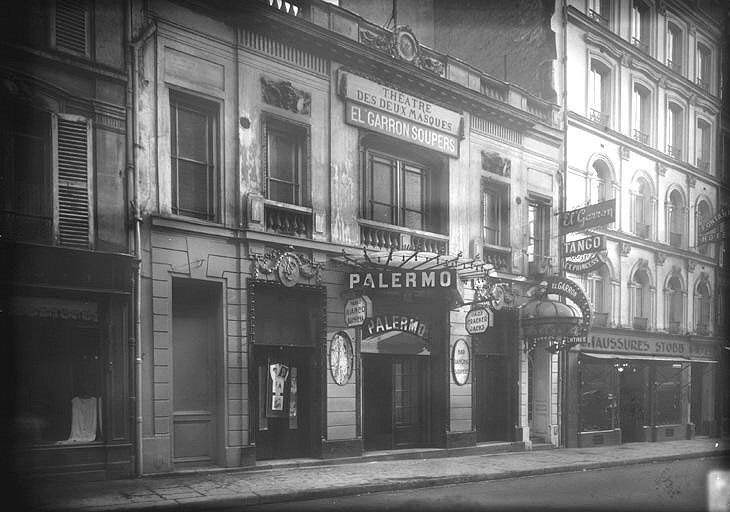
Argentine restaurant "Palermo" and night club "El Garron", immortalized in several songs, where tango has found a safe haven during the worst years of Great Depression, when pretty much all the bands in BsAs went bust or stopped playing for the dancers. 

Remembering Paris ... "I came as a wanderer who lost faith. I arrived to Paris, loaded with pain. The City of Light has become like the Sun for me. Your love brought me back to life!"

Fui…
Vagabundo sin fe y sin amor.
Que…
Llegué un día a París con mi dolor.   
Yo…
Te encontré como un sol, mi amor!
Y…
Por tu amor yo viví...


Back home in Buenos Aires, a lone tango band keeps on playing for the dancers in the seediest establishment near the port, called, in English, "Ocean Dancing". The conditions must be too bad for the Argentines to take the job, but these guys are Uruguayans, and their homeland is hit by the economic crisis even harder. So Edgardo Donato and his musicians press on.

The 1932 "Hurricane" presages the rebirth of tango, planting the seeds of crazy energy. And what a storm it is! This hurricane isn't an atmospheric phenomenon, actually. She is a woman who destroys the metaphorical rose garden of love. Never again shall it bloom!


Reborn milonga as the only feminine heroine of tango?

"Milonga brava". A feminine protagonist, but not really a human being of flesh and blood "I am a milonga, I have no fear. I am a sound motif which progress with a swaggering gait. I was sung by the girl with sweet lips, and then they danced me on the broken flagstones of the tenement with the boy from upstairs".


Yo soy la milonga brava
Candombera y entradora.
Yo soy la milonga brava
Candombera y entradora.
Yo soy la expresión sonora
Que el progreso deshilacha,
Canción me hizo una muchacha
De boca fresca y golosa.
Y me bailó en la baldosa
Quebrada del conventillo,
Con el mozo del altillo
A quien le dio el corazón.


Young, fun, irreverent … too irreverent?
Juan D'Arienzo was derided for his youth appeal which, in hindsight, probably saved tango from total destruction. Hes fans were said to be too shallow, too preoccupied with beat, and, well, stupid. Who else would welcome tangos like this one, about hiccups? (Wait, there was one about farts, too).

A boy meets a girl in a club, but when it's time for sweet talking, he's suddenly overcome by hiccups. ( "I dream of turning into a gentle breeze which will caress your body ... HIC!!!")


The rumblings of the new, cleansing revolution...

Tango director Lucio Demare and his brother, movie director Lucas Demare, set out to change the regime and bring the country back from the morass of corruption and infamy. The social networks aren't there yet, but the brothers have music and movies at their disposal - and in 1942, they accomplish it, and a populist regime takes the reigns of power. A grand cleansing is in order, and one its first targets are the "degraded" lyrics of the tango songs. The following song is Demare's own. Can you figure out what has changed in the recording?

¿Quién pena en el violín?
¿Qué voz sentimental?
Cansada de sufrir
Se ha puesto a sollozar así...
Tal vez será su voz
Aquella que una vez,
De pronto se apagó...
Tal vez será mi alcohol
Tal vez...!
Su voz no puede ser
Su voz ya se durmió,
Tendrán que ser, nomás
Fantasmas de mi alcohol...


The censorship employs scores of the mediocre "lyrics hacks". Slang, crime, booze, gambling, everything must be removed. Some songs are simply unsalvageable. Luckily, a year later, the government reverses its course. But an amazing thing happens. The music industry realizes that tango doesn't have to be fast, or racy, or risque, to sell!

Tango itself becomes its own, beautiful subject

One of many veritable anthems of tango is :Una emocion", "A feeling", a manifesto song about tango itself... about its being simply a beautiful emotion which wins hearts without a pretense or a special effort...

translated by Derrick del Pilar

Wrapped up in a dream last night I heard it—
an emotion composed of things from my yesterdays:

The house where I was born,
the iron fence and the ivy,
the old carousel, the rosebush.

Its accent is the song of an emotional voice,
its rhythm is the measure that lives in my city—
it has no pretensions,
it doesn’t want to be lewd,
it’s called tango, and nothing more.


Tuesday, March 5, 2019

The time and place of Saverio Sadan

Just a few months ago I lamented that the memory of the legendary Ukrainian tango composer from Ukrane, known in Argentina as "Saverio Sadan", is lost to the ravages of time. His "Gitana Rusa", composed in 1940, soon took Argentine by storm - but the fiddler and composer was no longer around to learn about its success.
The town of Uman is famous for its 220 years old
landlord Potocki's park

The "Russian gypsy girl", as "Gitana rusa" is translated, has a heart-wrenching story. Its author, a violin player from Uman in Ukraine (whose real name was guessed to be Savely Zhadan) was murdered along with the rest of the town's Jews in the mass executions of the "Holocaust by bullets" in the fall 1941. Zhadan's son lived in Buenos Aires. I read that his mom took the boy to Argentina, supposedly in 1921, and that the son of the Ukrainian musician, remembered as Demetrio Sadan in Argentina, grew up to become a banking executive (the reality turned out to be more exciting and more mysterious - read on!). The story went on that when Demetrio fell in love for his secretary Celia, his dad sent him a unique wedding gift: a tango entitled "Your eyes" ("Tus ojos") and dedicated to "beautiful Celia". The musical score had to be smuggled out of the USSR with a friendly merchant marine sailor through the port of Odessa, It arrived late for the wedding, in the end - and it doesn't seem like the groom had much appreciation for the music, even his father's music, anyway. But as the year 1941 dragged on, Demetrio had a clear premonition that his father was no longer alive. At some point, he must have decided to pass Saverio's creation into good hands.

The tango poet Horacio Basterra Sanginetti, a tragic genius of the Castellano verse, rewrote the lyrics of  Sadan's tango in Spanish, staying true both to the original title and to the aura of fate born by Sadan's score in the opening lines of the letras: "You eyes are colored jet-black by the pain of suffering". The song goes on about parting forever, about death, sorrow, and the snow-covered steppe...
I must add that there are few tango personalities more mysterious than Horacio Sanginetti. Not a single photograph is known of this poet of "Nada", “Alhucema”, “Liula la misteriosa”, “María Morena”, “El barrio del tambor”, “Macumba”, and “Corazón de tambor”. Doomed to exile, Horacio Sanginetti died in complete oblivion on the age of 43.
But the composer of "Gitana rusa" was a far greater mystery... we didn't even know his real name. Argentine Saverio is a variation of Xavier, but the historians assumed that it really stood for a similar-sounding Russian name Savely (Saul). I would have guessed that the actual name was Shevel. That's how the name of the first Israeli Kind Saul sounded in Yiddish. My own great great grandfather bore this name, which meant "prayed for" or"blessed". But the answer to this riddle was hidden in the death-pits of the Holocaust.

Nevertheless, the digital age of the XXI century returns the lost names to life, bit by bit. And today, I spotted the name of the musician in the digitized vital records of Cherkassy Regional Archive. This is the August 1922 record of Zhadan's 2nd marriage:

His name is indeed Shevel Zhadan, son of Israel. He is a teacher at the municipal music school, residing at the Catholic Church Street #5,  Shevel is born in 1890 (and we know that he was murdered by the Nazis in 1941). It must be noted that the residence, and the school, still stand (and look as if they didn't have renovations in the 100 years which passed).

May his soul be bound in the bonds of life.
ת.נ.צ.ב.ה


Yet I still couldn't find any trace of Demetrio Sadan in Argentina. I used to think that I need to search post-1924 arrivals (since that's when the US slapped its punitive quotas on the Eastern European immigration, and the refugees from Ukraine were re-routed to South America). But even in the early 1920s, searching CEMLA database yielded nothing. Headstone searches, nothing either. Something must have been incorrect about Demetrio's name? Then the light bulb went on: it wasn't a poor family, so perhaps they vacationed in Brazil (and Brazilian immigration cards have been thoroughly digitized). And there I discovered that the musician's son wasn't a Demetrio Sadan, but rather Demetrio Zadán. The S and the Z don't sound any different from one another in Spanish there... His wife was Celia Herminia Piva. The oldest daughter, Angelica Maria Victoria Zadán was born in September 1939 (you can appreciate just how long it took for the news of Demetrio's wedding to rich his father in Ukraine! ). Monica Celia Victoria Zadán in NYC is the youngest of 3 daughters. The 2nd daughter, Alicia Ida Victoria Zadán, was born in 1942 and I can't resist adding at least one of their numerous immigration cards here. Isn't she adorable? 
This Alicia Zadán, an artist, married Juan Carlos Cáceres in Paris, and co-organized his Tango Negro events with him. All the billboards of Tango Negro are Alicia's designs! (I'm attaching a video of her interview to the Spanish language service Radio France, given soon after her husband's death). This stuff just makes me speechless. Wow, don't these tango genes skip a generation sometimes?


Having uncovered all that, I got a feeling that I already read somewhere about the Cáceres connection of "Gitana rusa". Another search and ... I grew speechless! It was right there in late Julio Nudler's 1998 book about the Jewish roots and personalities of Argentine tango. Yes, it was Juan Carlos Cáceres himself who showed Nudler the five yellowed pages of Shaul Zhadan's score, dated August 10, 1940. And Cáceres explained right then how he got into possession of this relic: that Demetrio Zadán was his father-in law! Demetrio the redhead newspaper editor and a friend of the poet Horacio Basterra (who signed his tango's "Sanguinetti"), explained Cáceres. Not some culture-averse financier as I read elsewhere. My interest was piqued.

The Uman-born son of Shevel Zhadan turned out to be a bright and outrageous journalist and poet, going by nickname Mitia (which is Russian diminutive for Dmitry - Demetrio). He cut his reporter's teeth as a teenage new immigrant under the mentorship of Jorge Luis Borges. The famous author, poet and culturologist worked then as an executive editor of a Saturday section of Crítica. Mitia Zadán joined the paper in June 1929, right out of high school. It was a very unusual paper, in some ways a tabloid with its 300,000 circulation and a gaudy colored design, but at the same time a conduit of high culture directed towards the wide masses of the porteños. The autobiographic sketch of "Mitia" Zadán's first days in journalism appeared there, too, as did his "Streets of Buenos Aires".
At the same time Demetrio-Mitia participated in the leftist youth's avant-garde magazine "Brújula" ("Compass"), "the monthly of arts and ideas", wrote poetry, and even published, in 1936, "Trapecio" - "a guide to the BsAs brothels in verse". No wonder he was friends with the great and scandalous tango poet Sanguinetti, who rewrote the lyrics of "Gitana rusa" and found the musicians willing to give the Ukrainian tango a try!

The details of little Mitia's long trip from Uman to Argentina turned out to be different, and more mysterious, than I thought, too. According to the family, mom abandoned him (and his father) just months after his birth, and went to Argentina. But the WWI flared up and separated the mother from her baby for nearly a decade! At last, the mother, who was by then happily married, sent for her redhead boy. The sources usually say that Demetrio was born in 1910, but sometimes, in 1912. I wondered if I could tell with more certainty about his parents and his birth from the vital records of Uman. Yet the mystery only deepened. I couldn't find his birth record in the Jewish books - but I discovered that Shevel Zhadan had a different boy with his legal wife - a different woman - in July 1913!

Motherland Monument at Mamayev Kurgan
Shevel Zhadan's son Israel, born July 7, 1913, was named after Shevel's deceased father. He went to school in Uman, and in WWII escaped the Nazi offensive which killed his father and was called up for the Battle of Stalingrad. Israel Mikhail Zhadan served in anti-tank artillery and survived the deadly assault on Mamayev Kurgan, the blood-soaked hill overlooking Stalingrad's downtown, and the sweeping attack on Italian and Romanian auxiliaries of Wehrmacht on river Don West of town. But on January 17, 1943 his 6th Guards Army encountered stiff resistance of the regrouped Germans on the outskirts of Rostov. Israel Zhadan was grievously wounded and died in a military hospital 3 months later.

Israel was a son of Mirlya Zhadan, who acccording to the records was the first of the two legal wives of of Shevel Zhadan (he was a widower when he remarried in 1922). But whose son was "Mitia", then? It sounds like his parents weren't legally married before the break-up.  Occasionally, I encountered "illegitimate" births in the Jewish vital books, but it didn't occur to me to check them. And, although cross-confession marriages weren't allowed then, the non-Jewish name Demetrio leaves open a possibility that his mom was Christian and, therefore, that his birth was recorded in different confession's books? Either way, if it was officially an illegitimate birth of a soon-abandoned child, then little Mitia could only have acquired his biological father's surname later, after the Bolshevik Revolution, when these possibilities opened up. The mysteries don't end,,,

Wednesday, February 20, 2019

Tango Snow and Fire weekend playlist, Jan 2019

I have a feeling that I'm doing the playlist publication for the final time. The old-fashioned blog format is barely clinging to life in 2019, and my DJ aspirations have shrunk too, as the new generation of the local DJs has grown. And lastly, after so many years of comments about orchestras and songs, I rolled through some of the most important stories about the tango musicians, and the stories still left untold are kind of peripheral. In fact I couldn't make myself to format and comment this list for a whole month... but I finally got to it.
001. Enrique Rodriguez - Armando Moreno "No te quiero mas" 1940 2:18
002. Enrique Rodriguez - Armando Moreno "En La Buena Y En La Mala" 1940 2:28
003.  Enrique Rodriguez - Armando Moreno "Llorar por una mujer" 1941 2:47
004. Carlitos Rolan  "Cuarteto2"  0:19
Get prepared to listen to Troilo's beautiful vals, "Flor de lino", "The flower of flax", often :) The beautiful celestial blue flower has become the mascot of our spring festival of tango. Let's all get excited about SLTF 2019 and welcome old friends of our community, Rod Relucio and Jenny Teters from Chicago, and first-time comers to Salt Lake Valley, Erin Malley and Doruk Golcu!!!
005. Anibal Troilo - Floreal Ruiz "Flor De Lino" 1947 2:49
006. Aníbal Troilo - Floreal Ruiz, Edmundo Rivero  "Lagrimitas de mi corazón" 1948 2:59
007. Anibal Troilo - Edmundo Rivero  "A unos ojos" 1949 3:10
008. Los Iracundos  "Puerto Montt rock" 1971 0:27
009. Osvaldo Fresedo - Roberto Ray "Nieblas del riachuelo" 1937 2:25
010. Osvaldo Fresedo - Roberto Ray "Sollozos" 1937 3:27
011. Osvaldo Fresedo - Roberto Ray "Recuerdos De Bohemia" 1935 2:36
012. Maya Kristalinskaya  "A za oknom"  0:16
Di Sarli and his band, from tangosalbardo blog
January is a wonderful opportunity to celebrate Carlos Di Sarli, the unsurpassed genius of elegance. He was born in Bahia Blanca on January 7, 1903. From the very first records of his orchestra in 1940 to the very last ones in the late 1950s, Di Sarli had an amazing knack for taking really old, really rough tango of his childhood, and making them shine like gemstones. This trio of Old Guard tangos reinterpreted by Di Sarli some two decades after they were composed is no exception. The first and the last ones are compositions of Ediardo Arolas (who even called his Model T a "Cachila", after a sparrow-like bird), the middle track has been composed by José Martínez. 
013. Carlos Di Sarli - Instrumental "La Trilla" 1940 2:21
014. Carlos Di Sarli - Instrumental "La Torcacita" 1941 2:37
015. Carlos Di Sarli - Instrumental "La Cachila" 1941 2:46
016. Soda Stereo  "Corazon elator"  0:28
Ricardo Tanturi was born on January 27, 1905, in one of the poorest barrios of Buenos Aires. Like his start singer, Alberto Castillo, he was a medical school graduate, but like Castillo, he gave up practicing medicine to play tango. Tanturi didn't call his band an "orquesta tipica". Instead, it was called "Los Indios", "The Indians" - not after the native tribes but after the favorite sports club. They always opened each live performance with the eponymous tango! 
017. Ricardo Tanturi - Alberto Castillo "La Vida Es Corta" 1941 2:26
018. Ricardo Tanturi - Alberto Castillo "Pocas palabras" 1941 2:27
019. Ricardo Tanturi - Alberto Castillo "La copa del olvido" 1942 2:31
020. Alla Pugacheva  "Etot mir"  0:33
Humorous and energetic valses of the following tanda let me showcase another January birthday boy, the singer Francisco Amor who shares the birthday and the birth place with Carlos Di Sarli (January 7, 1906, Bahia Blanca). Of Amor's long and distinguished career, we remember the most his 3 years with Francisco Canaro.
021. Enrique Rodriguez - El "Chato" Flores "Salud, Dinero Y Amor (Vals)" 1939 2:39
022. Francisco Canaro - Francisco Amor  "La zandunga" 1939 3:16
023. Francisco Canaro - Francisco Amor  "Cuando estaba enamorado" 1940 2:48
024. "Entry of Winter"  0:37
Roberto Rufino, "the kid from Abasto", one of the signature voices of Di Sarli's orchestra, is also a January birthday boy (born January 6, 1922). These hits from the romantic revival period pioneered by Di Sarli late in 1941, and soon adopted by the rest of tango orchestras.
025. Carlos Di Sarli - Roberto Rufino "Decíme Que Pasó" 1942 2:39
026. Carlos Di Sarli - Roberto Rufino "Adios te vas" 1943 2:27
027. Carlos Di Sarli - Roberto Rufino "Canta pajarito" 1943 3:16
028. Gilda  "Noches Vacias cortina"  0:22
Andrés Falgás, one of the quintessential voices of Biagi's orchestra, was born on January 15, 1916. A first-generation immigrant kid, he won his first tango prize at 17 and cut his first recording at 20. He spent most of his adult life touring Latin America. They made only 11 recordings in his mere 9 months of work together with Biagi, but these songs are spectacular.
Biagi and Falgas at Luna Park - from Tangoarchive
029. Rodolfo Biagi - Andrés Falgás "Queja Indiana" 1939 2:24
030. Rodolfo Biagi - Andrés Falgás  "A mí no me interesa" 1940 2:43
031. Rodolfo Biagi - Andrés Falgás  "Son cosas del bandoneon" 1939 2:44
032. Vitas  "7, the element cortina" 2012 0:23
Di Sarli and Rufino again. Favorite milongas.
033. Carlos Di Sarli - Roberto Rufino "La Mulateada" 1941 2:22
034. Carlos Di Sarli - Roberto Rufino "Pena Mulata" 1941 2:27
035. Carlos Di Sarli - Roberto Rufino "Yo Soy De San Telmo" 1943 2:20
036. Alla Pugacheva  "Winter Night (Svecha gorela) cortina"  0:19
and we return to Francisco Amor's vocals - now in the genre of tango
037. Francisco Canaro - Francisco Amor "Cuartito Azul" 1941 2:43
038. Francisco Canaro - Francisco Amor "Copa de ajenjo" 1941 2:28
039. Francisco Canaro - Francisco Amor "En esta tarde gris" 1941 2:58
040. The Red Elvises "Cosmonaut Petrov 2 (-2 dB)" 1999 0:20
041. Edgardo Donato - Horacio Lagos "Se Va La Vida" 1936 2:44
042. Edgardo Donato - Horacio Lagos y Romeo Gavioli "Amando en silencio" 1941 2:51
043. Edgardo Donato - Lita Morales y Romeo Gavioli "Yo Te Amo" 1940 2:50
044. Alla Pugacheva  "Etot mir"  0:33
... and to the voice of Andrés Falgás, with valses
045. Rodolfo Biagi - Andrés Falgás  "El último adiós" 1940 2:09
046. Rodolfo Biagi - Andrés Falgás  "Dichas que viví" 1939 2:17
047. Rodolfo Biagi - Andres Falgas  "Dejame amarte aunque sea un dia" 1939 2:55
048. Gilda  "Noches Vacias cortina"  0:22
Paying homage to Di Sarli's earliest records, from before the Great Depression made him quit the bandleader job for much of the 1930s...
049. Sexteto Carlos di Sarli - Instrumental Carlos Di Sarli "Belen" 1929 2:44
050. Sexteto Carlos di Sarli - Ernesto Fama Carlos Di Sarli "Flora" 1930 2:38
051. Orquesta Tipica Victor (dir. A. Carabelli) - Instrumental "Coqueta" 1929 2:47
052. Gogol Bordello  "Pala Tute cortina 1" 2012 0:18
Tanturi's orchestra is best known by their vocal records, and when I play his instrumentals, it often ends up being a mixed vocal / instrumental set. But tonight, we are going for a whole tanda
053. Ricardo Tanturi - Instrumental "Argañaraz" 1940 2:22
054. Ricardo Tanturi - Instrumental "El buey solo" 1941 2:45
055. Ricardo Tanturi - Instrumental "Una Noche De Garufa" 1941 2:29
056. Lidiya Ruslanova  "Valenki 3 (cortina)"  0:24
With the Uruguayan  milonga tanda, I get a chance to celebrate Emilio Pellejero. As it usually happens with Uruguay, records are sparse (just 7 over 6 years!) and of uneven quality. And bios are a mystery. A birthday of January 1, 1911 is given, and it's about as much as I could figure out. But what a milonga!
057. Emilio Pellejero - Enalmar De Maria "Mi Vieja Linda" 1941 2:26
058. Ángel Sica - Roméo Gavioli "Rebeldia" 1942 2:20
059. Miguel Villasboas - Instrumental "La Milonga Que Hacia Falta" 1961 2:18
060. Alla Pugacheva  "Winter Night (Svecha gorela) cortina"  0:19
061. Osvaldo Fresedo - Roberto Ray  "Ojos tristes | Ojos muertos" 1938 2:37
062. Osvaldo Fresedo - Roberto Ray  "Dulce amargura" 1938 2:29
063. Osvaldo Fresedo - Roberto Ray "Angustia" 1938 2:39
064. Victor Tsoy  "Gruppa Krovi (cortina long)"  0:36
065. Fervor de  Buenos Aires  "Quien Sos" 2007 3:08
066. Fervor de Buenos Aires  "E.G.B." 2007 2:26
067. Ojos De Tango  "El Adios" 2011 3:13
068. Gilda  "No Me Arrepiento de Éste Amor cortina long"  0:40
069. Color Tango  "Illusion de mi vida" 2005 3:00
070. The Alex Krebs Tango Sextet  "Romance de Barrio" 2011 2:41
071. Osváldo Pugliese  "Desde El Alma" 1943 2:56
072. Alla Pugacheva "Million Scarlet Roses" 1982 0:19
We return to Tanturi's best hits - now the melodic ones, with the vocal of Enrique Campos
073. Ricardo Tanturi - Enrique Campos "La Abandone Y No Sabia" 1944 2:50
074. Ricardo Tanturi - Enrique Campos "Oigo Tu Voz" 1943 3:07
075. Ricardo Tanturi - Enrique Campos "Que Nunca Me Falte" 1943 2:42
076. Alla Pugacheva  "Etot mir"  0:33
Hector Varela, born on Jan 29, 1914, with his dramatic hits of the 1950s, is a perfect match for the crazy last hours of a good tango event. One may forget that Varela was a disciple, and arranger for, Juan D'Arienzo, and directed his own rhythmic, youthful tangos in the 1930s.  
077. Hector Varela - Argentino Ledesma "Fueron tres años" 1956 3:26
078. Hector Varela - Argentino Ledesma "Muchacha" 1956 3:19
079. Hector Varela - Argentino Ledesma "Si me hablaras corazon" 1956 3:18
080. Zhanna Aguzarova "Old Hotel" 1987 0:22
Atahualpa Yupanqui in Paris, from Clarin
It's time to pay homage to the great Argentine folklore singer Atahualpa Yupanqui (born Héctor Roberto Chavero on Jan 31, 1908). A son of a mestizo father, he adopted the names of Inca royals for his scenic names. Communist beliefs caused Atahualpa Yupanqui many years of exile and many arrests, but he worked tirelessly to promote the folk motifs of the Pampas, including Southern, or Pampas, milonga style which permeates this slow milonga tanda. "Los Ejes De Mi Carreta", composed and frequently performed by Yupanqui, has been recorded by such classic tango orchestras as Canaro and Troilo, but I am more partial to this contemporary Peruvian cover:
081. Paco Mendoza & DJ Vadim  "Los Ejes De Mi Carreta" 2013 3:23
082. Hugo Diaz Trio  "Milonga Para Una Armonica" 1974 4:24
083. QTango Erskine Maytorena Qtango "Milonga Triste" 2011 4:17
084. Zhanna Aguzarova  "Miracle Land cortina"  0:31
085. Edgardo Donato - Romeo Gavioli y Lita Morales "Mi Serenata" 1940 3:01
086. Edgardo Donato - Horacio Lagos, Lita Morales y Romeo Gavioli "Sinfonía De Arrabal" 1940 3:09
087. Edgardo Donato - Horacio Lagos y Lita Morales "Carnaval De Mi Barrio" 1939 2:23
088. Edgardo Donato - Horacio Lagos y Lita Morales "Sinsabor" 1939 2:53
089. Zhanna Aguzarova  "Zvezda (The Star)" 1984 0:28
Violinist and bandleader Florindo Sassone was born an Jan 12, 1912 in Buenos Aires. A disciple of Fresedo and a fan of Di Sarli, Sassone was a master of melodic elegance in his own right. He made a stellar tango career in the 1930s, but, just as the tango music scene was beginning to get crowded by 1940, the 28 years old musician called it quits. So Sassone missed being a part of Tango's Golden Age. Yet he came back and organized his own orchestra again in the late 40s, and gradually returned to fame. And carried the flame of tango through its darkest era of the 1960 and 1970s, innovating, bringing tango to the international audiences, even remixing several antebellum European hits in the authentic Argentine style. Such tangos as The Song Of The Rose from the movie Casablanca, or Tango Notturno from the eponymous German talkie. But the one most dear to my heart is, of course, his cover of the 1928 Russian hit, "Ojos Negros".  

090. Florindo Sassone - Instrumental "Ojos Negros (Oscar Strok)" 1968 2:28
091. Florindo Sassone - Instrumental "Adios corazon" 1968 2:16
092. Florindo Sassone - Instrumental  "Bar Exposicion" 1968 3:26
093. Soda Stereo  "Profugos"  0:33
094. Enrique Rodriguez - El "Chato" Flores  "Las Espigadoras" 1938 2:47
095. Enrique Rodriguez - El "Chato" Flores "Los Piconeros (Vals)" 1939 2:47
096. Enrique Rodriguez - Armando Moreno  "En el volga yo te espero" 1943 2:40
097. Alla Pugacheva  "Winter Night (Svecha gorela) cortina"  0:19
we close the tributes with a beautiful dramatic vocal tanda of Di Sarli's late years
098. Carlos di Sarli - Mario Pomar  "Patotero sentimental" 1953 3:02
099. Carlos di Sarli - Mario Pomar  "No me pregunten por qué" 1952 3:33
100. Carlos di Sarli - Mario Pomar  "Duelo Criollo" 1953 2:25
101. Soda Stereo  "En la ciudad de furia"  0:24
102. Donato Racciatti - Olga Delgrossi "Hasta siempre amor" 1958 2:57
103. Donato Racciatti - Olga Delgrossi "Queriendote" 1955 2:49
104. Donato Racciatti - Olga Delgrossi "Sus Ojos Se Cerraron" 1956 2:47
105. Viktor Tsoy  "Good morning, last Hero cortina long" 1989 0:35
106. Alfredo de Angelis - Instrumental  "Mi Dolor" 1959 2:51
107. Alfredo de Angelis - Instrumental  "Pavadita" 1958 2:53
108. Alfredo de Angelis - Instrumental  "Felicia" 1969 2:48
109. Alfredo de Angelis - Instrumental  "La cumparsita (Matos Rodríguez)" 1961 3:35