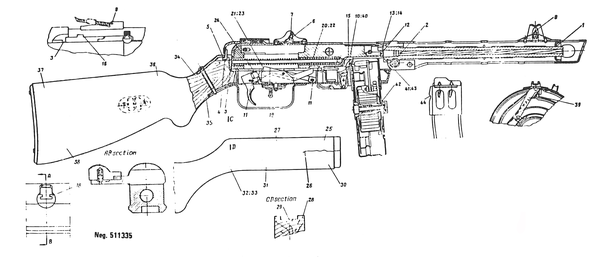
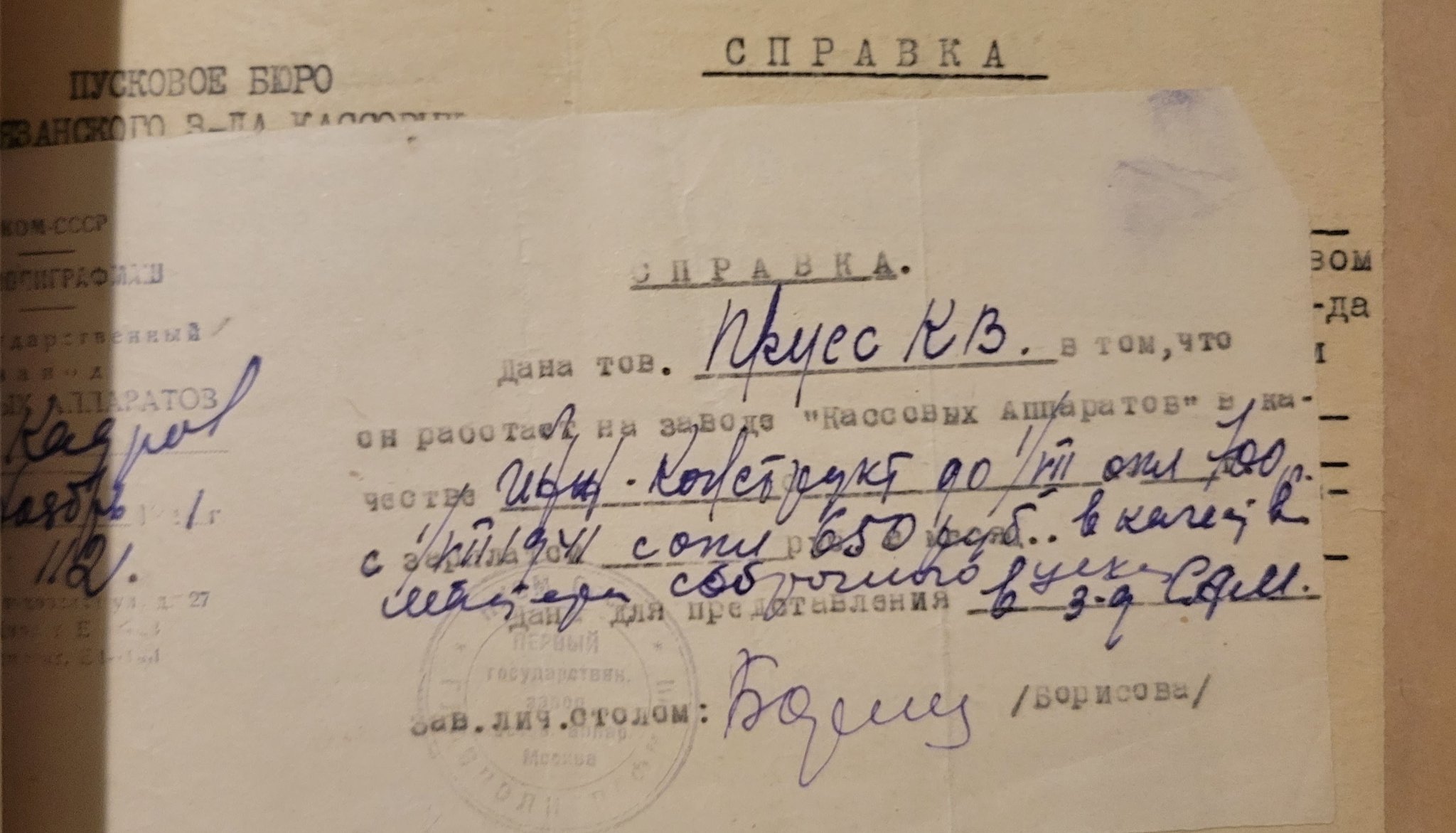
But the calculus changed when, at 26, he suddenly became a son and a brother of the condemned enemies of the people. With the top-clearance jobs now out of reach, Karl settled for a far less glorious engineering position at SAM, a factory manufacturing mechanical calculators and typewriters. When the Wehrmacht invaded Russia, he was on a launch team of a mechanical cash register production. These decidedly civilian products were being hurriedly replaced by war materiel, and by August 1941, less than two months after the invasion started, SAM started making submachine guns on a trial basis. By then the Germans had already advanced over 300 miles. Karl's aunts and cousins in Belarus were trapped behind the German lines; none will survive the war. Hundreds thousand draft-ineligible men from Moscow were sent to People's Militia divisions to man an additional line of defense around Moscow, just in case the Germans break through. Karl was ordered to keep his job, now deemed too important for the defense effort.
Monday, May 1, 2023
Tango at a factory where my grandfather made WWII submachine guns...
But the calculus changed when, at 26, he suddenly became a son and a brother of the condemned enemies of the people. With the top-clearance jobs now out of reach, Karl settled for a far less glorious engineering position at SAM, a factory manufacturing mechanical calculators and typewriters. When the Wehrmacht invaded Russia, he was on a launch team of a mechanical cash register production. These decidedly civilian products were being hurriedly replaced by war materiel, and by August 1941, less than two months after the invasion started, SAM started making submachine guns on a trial basis. By then the Germans had already advanced over 300 miles. Karl's aunts and cousins in Belarus were trapped behind the German lines; none will survive the war. Hundreds thousand draft-ineligible men from Moscow were sent to People's Militia divisions to man an additional line of defense around Moscow, just in case the Germans break through. Karl was ordered to keep his job, now deemed too important for the defense effort.
Sunday, April 30, 2023
Mixed vals tandas
A fiery tanda with Castillo's voice but without the nearly-obligatory Violetas:
1. Orquesta Tipica los Provincianos (Ciriaco Ortiz) - Alberto Gomez "Samaritana" 1932 2:58
2. Alberto Castillo "Idilio Trunco" 1946 2:08
3. Edgardo Donato - Horacio Lagos, Lita Morales, Romeo Gavioli "La shunca" 1941 2:35
An instrumental and surprisingly modern-sounding tanda:
1. Juan De Dios Filiberto - Instrumental "Tus Ojos Me Embelesan" 1935 2:34
2. Cuarteto Roberto Firpo - Instrumental "Para Las Chicas" 1942 2:11
3. Cuarteto Tipico Los Ases (Juan Carlos Cambon) - Instrumental "Invernal" 1941 2:42
Excellent songs joined together:
1. Francisco Lomuto - Fernando Diaz "Cuando estaba enamorado" 1940 2:19
2. Enrique Rodriguez - Roberto Flores "Salud Dinero Y Amor" 1939 2:39
3. Orquesta Típica Víctor - Ángel Vargas "Sin Rumbo Fijo" 1938 2:18
Rich, complex, breathtaking:
1. Alfredo de Angelis - Juan Carlos Godoy "Angélica" 1961 2:41
2. Héctor Varela - Argentino Ledesma y Rodolfo Lesica "Igual Que Dos Palomas" 1953 2:36
3. Enrique Rodriguez - El "Chato" Flores "Las Espigadoras" 1938 2:47
Tuesday, January 7, 2020
Joaquina Carreras - the first female tango estribillista?
![]() |
| Joaquina Carreras sings. A frame of Ariel's audiovisual recording |
The parallels with the suppressed story of Lita Morales were uncanny, and left no doubt that, like Lita, Joaquina Carreras must have quit the world of tango, and possibly with bad blood. So at a first spare moment, I went searching for "the real Joaquina" - but unlike the mystery case of Lita Morales, the life path of Joaquina Carreras came to light relatively quickly. She turned out to be a bit of a transient, only coming to BsAs in the second half of the 1920s, and leaving when the Great Depression decimated the artistic world of Argentina. I still don't know what pushed the Argentine tango world to forget her, but possibly it was just the fact that she was a foreign interloper - and a woman in the genre of tango-for-dancing which continued to adamantly reject women for another decade... Of many feminine voices in tango then, all without an exception sang "tango for listening", for the radio and the concert, for the daylight hours. No decent women were yet allowed at night in the sacred and obscene universe of the milongas. So let's pay tribute to the female trailblazer, Joaquina Carreras Torres!
Joaquina was born in 1892 in Seville in the family of a well-known actor Emilio Carreras López. Her father died when she was 23, and in the early news clips about Joaquina, she is invariably called "a beautiful daughter of her untimely departed father". Like her father, Joaquina Carreras acted in comedies,in the theater plays and in the movies, but she's become best known for her soprano voice and her love of folk songs.Her first known foreign tour was to Cuba in 1921 in a large artistic troupe with her new husband Jose Encinas and their just-born first baby Joaquina Jr. The 21 Sep 1921 New York arrival record of S.S. "Buenos Aires" from Barcelona (in transit for Havana) lists Joaquina as a 20 years old resident of Madrid with blue eyes, 4 ft 11" (some later accounts describe her as a psychologically towering presence, no doubt with an element of a pun). Of course her real age was closer to 29 then, but since her actor husband was several years younger, she must have preferred a little adjustment of age. Joaquina's husband tragically died in 1923, but in the 1924 and 1925 we find her in the entertainment sections of Spanish newspapers as an actress and singer based in Madrid.

In 1929 she records 3 valses and 2 tangos with Guido, in her trademark folk-song style especially evident in their "Valsecito del Antes". The most surprising thing about these records is that she sings estribillo solamente, only the bridge, without the stanzas. This approach was introduced specifically for the dancers by the ever-experimenting Francisco Canaro only a few years earlier, in 1924 (until then, tangos for dancing were strictly instrumental, while vocal tangos for listening, initially also known as tango milongas, always used the complete text with all the stanzas). Estribillista singing is stricktly para bailar, yet no women were allowed to sing for the dancers ever before or for many years after! In the same year Joaquina Carreras takes part in an experimental audiovisual recording of the Ariel studio. Then she records a few pasodobles and fado with Carabellli. And in 1932 she participates in the first experimental TV broadcast in South America!
By 1934, Joaquina Carreras is back in Madrid, singing with the studio sextet of the Union Radio La Palabra and performing in comedies I couldn't resist adding one of the radio program clippings here, because there, in May 1936, she sings "Ojos negros - cancion popular rusa". Of course it must be the tango remix of the famous "Dark Eyes" premiered a year earlier by the spectacular Imperio Argentina (see an earlier story on this blog) As the nation is ravaged by the Civil War and Madrid is besieged, Joaquina briefly disappears from sight again, but beginning in 1940, she's back again, acting in Spanish movie comedies. She died on Nov 20, 1954 in Madrid. Interestingly, her daughter Joaquina "Jr." Encines Carreras moved to Buenos Aires after her mother's death!

Sunday, January 5, 2020
The Melodists: the family at the roots of Polish jazz and tango
I knew that Jerzy Petersburski belonged to the storied clan of Jewish musicians whose surname, the Melodists, speaks for itself. I also understood that the famous Gold-Petersburski band included Jerzy's brother and several cousins, and somehow I assumed that Petersburski was just a scenic name, a capital-city calling card adopted for publicity (just like another trailblazer of Polish jazz and tango was a Warszawski after Poland's illustrious capital). But a chance conversation about (extremely rare) Jewish surnames derived from the cities in Russia's hinterland - such as St. Petersburg - made me revisit the family story of the Peterburskis and the Melodists, and discover the pivotal role the family ties played in birth of Polish jazz and tango. Oh, and yes, the surname "Petersburski" turned out to be a real family name, not a marketing invention at all!
![]() |
| Jakub-Lejzer Melodysta's forgotten, broken gravestone in Warsaw |
![]() |
| Eleonora Melodist, a Soviet opera star, was the most famous of Jakub-Lejzer's children |
Three of Paulina's brothers were musicians in Radom, but for our story it's more important to know that Paulina's uncle, Jakub-Lejzer Melodysta, a violinist, moved to Warsaw. Later on, Paulina's husband bought a bronze wares factory in Warsaw and moved there too. So the Petersburski kids became closely associated with Jakub-Lejzer's musician children and grandchildren in Warsaw.And what a constellation of talents it was! Jakub's sons Panfyl played alt in the Philharmonic and Ignacy lead bands, and daughters Maria and Eleonora starred in the opera. And Jakub's son-in-law Michel Gold played flute in the Warsaw Opera.
![]() |
| The 1922 ads for Danzig's Ermitage restaurant featured "first class jazzband trio of Karasinski" in German, or "Karasinski-Melodyst-Petersburski trio" in Polish |
![]() |
| Fred Melodyst (banjo) with his 1927 jazz band at a Polish mountain resort of Zakopane |
OK, now it's time to tell more about the Golds (sons of Helena (Chaske) Melodysta and Michel Gold).
Henryk Gold was the mastermind and his brother Artur Gold (violin) and Jerzy Petersburski, the top talents of the Gold-Petersburski band which recorded so many tango hits; Stanislaw Petersburski (piano) played there as well. Their names were so synonymous with the music of the Warsaw nightlife that they even had a special song recorded about them:
Gdy Petersburski razem z Goldem gra Muzyka: Artur Gold Slowa: Andrzej Włast 1926 Strajkuje ten i ów Podskoczył dolar znów A pan Zdziechowski miał w komisji Kilka nowych mów Nie przejmuj tem się nic Uważaj to za witz I słuchaj sobie w „Qui Pro Quo” Z pogodą lic Jak Petersburski razem z Goldem gra Z jazzbandu te Ajaksy dwa Sam pan Świejkowski W humor wpada boski I przy małżonce swej Szalejmy, krzyknie, hej Gdy Petersburski razem z Goldem gra Nie zaśniesz w nocy, aż do dnia I podczas tańca będziesz myślał Że minęła chwila zła Gdy Petersburski z Goldem gra Mąż pewien w nocy raz Do sal Oazy wlazł A widząc żonę z gachem Krzykną: Ach! Złapałem was! Rewolwer wyjął i Ponuro zmarszczył brwi Lecz nagle zaczął śmiać się Mówiąc: przebacz mi | Where Petersburski and Gold play together Music by Artur Gold Lyrics by Andrzej Włast (Gustaw Baumritter) 1926 Strikes here and there, The dollar jumped again, And the Treasury Secretary Zdziechowski Said so many new words about it Don't you worry about anything Take it all as a joke And enjoy listening at "Qui Pro Quo" With the most serene faces How Petersburski plays with Gold, The jazzband's two Ajaxes. Even Mr. Świejkowski the mortician Falls into a jolly mood And in the presence of his wife Yells "Hey!" like a madman When Petersburski plays with Gold You won't fall asleep at night until daylight And while you are dancing you will think That the evil moments have passed When Petersburski and Gold play One night, a certain husband Entered the halls of the Oasis And, seeing his wife with a lover. Shouted: "Aha! Gotcha!" He pulled out a handgun and Frowned dejectedly, But suddenly burst into laughing Saying: forgive me |
![]() |
| Eddie Rosner with the State Jazz of Belorussia, 1941 |
![]() |
| A concert program in the Polish Library of Buenos Aires featured the compositions of Jorge Petersburski... |
![]() |
| Black and White Ball of 1966, the high mark of New York opulence (from the Plaza hotel website) |
| The Golds' US immigration record |
But the most improbable escape from the claws of death was pulled by the family of another Polish jazz and tango pioneer Henryk Wars (Warszawski), the creator of a 1928 hit, "Zatańczmy tango" ("Let's Dance Tango!"). Henryk was called up to the Polish Army at the start of WWII, and taken prisoner by the Nazis, but escaped and reached Russian-controlled areas. But his wife and two kids remained trapped in Warsaw ghetto. Luckily, Henryk Wars was based in Lwow early in his jazz career, and composed some of the city most beloved songs, including its unofficial anthem, "Tylko we Lwowie" ("Only in Lvov").
![]() |
| Henry Wars's marching band in Tehran (from USC archive) |
![]() |
| Diana Mitchell and Robert Vars talk about the life of their father at a memorial concert featuring his music at the LAMOTH in 2017 |
In the late 1960s Vars returned to Poland, almost at the same time as Jerzy Petersburski. But it was more like a celebrity tour, recording and conducting before coming back to Hollywood. Henry Vars's children Diana (Danuta) Mitchell and Robert Vars and grandson Dennis Mitchell are still in Los Angeles, and keep Henry's memory alive (although the family business is law rather than the music now). They are even working on getting Henry's unknown symphonic compositions to the public!
Sunday, September 29, 2019
The inherent contradictions of following...
![]() |
| Maybe for my lack of imagination, I reused an image from my other "translated wisdom" blog post about the art of active following. |
Saturday, September 28, 2019
Unusual and experimental tandas
For Julio Sosas's February birthday, I went through tons of his recording and ended up building just one mixed tanda with a lone Sosa track for the Junando practica. We don't hear much Julio Sosa at our milongas, obviously, but it could have been very different, had El Varon del Tango not died so early, at 38! Julio Sosa was born on February 2, 1926, in the poverty-stricken outskirts of Montevideo in Uruguay. One of his many early jobs was with a provincial orchestras there, but it paid too little to make ends meet, and at 23, Julio quit it to sing in the cafes of BsAs. Soon, he was noticed, and got a succession of jobs with the 2nd tier tango bands, and finally, in 1960, convened his own orchestra. By all accounts, it was a wrong time to start a tango band. The government support for the national music of tango disappeared with the violent overthrow of Peron's populist regime, and the new happy-and-patronizing music of La Nueva Ola was all the rage. Even the master records of the Golden Age tango orchestras ended up destroyed to make room for more Nueva Ola studios! I wrote about the Dark Ages of Tango on this blog before, but I failed to mention that for a while, Julio Sosa held the lines against the onslaught of the new commercial music. Tall, masculine, young and charismatic, Sosa continued to attract the youth to tango - and not just to listen, but also to dance like himself. His disc sales rivaled those of La Nueva Ola! It all ended on November 26, 1964, when Julio crashed his Argentine-built sports car into a traffic light, the third speed car he totaled in quick succession, only this time it was fatal. With the death of its last iconic singer, tango never stood a chance...
The verdict: it is a passable vals tanda, good for a charged crowd later at night. But only Angelica really stands out...
Francini-Pontier - Alberto Podestá y Julio Sosa "El Hijo Triste" 1949 3:49
Alfredo de Angelis - Juan Carlos Godoy "Angélica" 1961 2:41
Héctor Varela - Argentino Ledesma y Rodolfo Lesica "Igual Que Dos Palomas" 1953 2:36
The most legendary tango dancer of the pre-Golden Age fame, Ovidio José "Benito" Bianquet, better known as El Cachafaz ("The Troublesome" / "The Outrageous" as the lunfardo word may be translated) was born Feb 14, 1885). El Cachafaz is celebrated in the lyrics of "Adiós, Arrabal", and that's why I decided to play the following relatively standard D'Agostino tanda during the same practica. Follow El Cachafaz label to read more about this awesome dancer who conquered the affections of the Parisians and triumphantly returned hone, only to lose it all in the post-Great Depression chaos. Who then rebuilt a show dancer's career from scratch when tango started to return to life, but died at 56 without witnessing the full bloom of tango's Golden Age.
Ángel D'Agostino - Ángel Vargas "Ahora No Me Conocés" 1940 2:35
Ángel D'Agostino - Ángel Vargas "Adios Arrabal" 1941 3:08
Ángel D'Agostino - Ángel Vargas "Ninguna" 1942 2:59
In March, I tried a really experimental - and not really recommended - tanda of super-late Calo instrumentals which are all the rage in Europe (it went OK really late at night though):
Miguel Caló - Instrumental "Luna del viejo castillo" 1964 2:37
Miguel Caló - Instrumental "Elegante papirusa" 1966
Miguel Caló - Instrumental "Para Osmar Maderna" 1963
You may know that I am not a big Troilo fan, and I usually stick to the few most reliable tracks of his, but in April I wasin the mood to experiment:
Anibal Troilo - Francisco Fiorentino "Pa Que Bailen Los Muchachos" 1942 2:49
Anibal Troilo - Francisco Fiorentino "No Le Digas Que La Quiero" 1941 2:51
Anibal Troilo - Francisco Fiorentino "Una Carta" 1941 2:48
The month of May is always a good reason to play more, and more varied, Fresedo than usual, since Osvaldo Fresedo was born on May 5, 1887. A son of a wealthy family, Fresedo created elegant music for the upper crust throughout his 60+ years-long tango career. In 1920, Fresedo has become the first tango bandoneonist ever to record in the United States when RCA Victor sent him to New York (they didn't yet have an up-to-date recording studio in South America then; the US-made record's, in Victor's typical anonymous house band fashion, went for sale in Latin America as "Orquesta Tipica Select"). Before the Great Depression, Fresedo's success was so great that he simultaneously maintained 5 "Fresedo orchestras" in Buenos Aires! One of these bands was directed by 24 years old Carlos Di Sarli, an admitted disciple of Osvaldo Fresedo who, in time, far surpassed his teacher. The economic collapse in Argentina put a stop to this exuberance, but Fresedo kept on playing, largely for the upper-class functions. He wouldn't play live for the dancers again, missing the tango dancing boom of the Golden Era, and he remains kind of shunned by the BsAs tangueros for this reason, although he recorded tangos through the 1980s. But nothing could be more mellifluous than Fresedo's 1930s and the early 1940s! This May, one of my Fresedo tandas was with the voice of Ruiz rather than with the "usual" Roberto Ray
Osvaldo Fresedo - Ricardo Ruiz "Y no puede ser" 1939 2:26
Osvaldo Fresedo - Ricardo Ruiz "Plegaria" 1940 2:24
Osvaldo Fresedo - Ricardo Ruiz "Buscándote" 1941 2:49
In June at Junando practica, it was time to return to De Angelis's Angelica which I already mentioned on this page:
Rodolfo Biagi - Hugo Duval y Carlos Heredia "Adoracion" 1951 2:52
Francisco Rotundo - Enrique Campos y Floreal Ruiz "El viejo vals" 1951 2:56
Alfredo De Angelis - Juan Carlos Godoy "Angélica (Vals)" 1961 2:43
There, I also put to test a fiery vals tanda with the voice of Alberto Castillo:
1. Ricardo Tanturi - Alberto Castillo "La Serenata (Mi Amor)" 1941 2:29
2. Alberto Castillo "Idilio Trunco" 1946 2:08
3. Alberto Castillo "Violetas" 1948 2:38
(3 total)
To start the playlists of September, I tried a more or less regular tanda but in an unusual place - as an opening tanda of Milonga sin nombre:
1. Orquesta Tipica Victor (dir. A. Carabelli) - Alberto Gomez "Ventarron" 1933 3:03
2. Orquesta Tipica Victor (dir. A. Carabelli) - Instrumental "Nino bien" 1928 2:43
3. Orquesta Tipica Victor (dir. A. Carabelli) - Instrumental "El chamuyo" 1930 2:46
September is a good time to remember the great singer Alberto Podesta (b. Sep. 22, 1924), who contributed so much to the success of the orchestras of Di Sarli, Calo, and Laurenz. And what would be a better fit to the themes of Podesta and September than his "Roses of Autumn"? Alas, I always had a hard time building a good tanda of Di Sarli's valses with this great hit. Trying to fix it now with a mixed-ochestra set:
1. Angel D'Agostino - Angel Vargas "Que Me Pasara" 1941 2:30
2. Manuel Buzon - Osvaldo Moreno "Pichon enamorado" 1942 2:18
3. Carlos Di Sarli - Alberto Podesta "Rosas De Otono" 1942 2:17
I also returned to the valses with the vocals of Castillo, then an ObGyn by day but a veritable mob lord voice by night.
1. Ricardo Tanturi - Alberto Castillo "Marisabel" 1942 2:23
2. Ricardo Tanturi - Alberto Castillo "Recuerdo" 1942 2:22
3. Ricardo Tanturi - Alberto Castillo "Mi Romance" 1941 2:16
Racciatti's tracks with the voice of Nina Miranda are a kind of a flashback to me. I first danced to Racciatti's when a Japanese DJ played a tanda with Nina Miranda's vocals, fell in love with her "Gloria" and "Tu corazon", and played them myself - good 5 years ago. But the quality of these 1952-1953 records in my hands then was substandard, and I started playing later-years Racciatti's tango with the voice of Olga Delgrossi instead. With a better recordings now, I return to Nina Miranda's hits. And what a pianist they had, by the way!
1. Donato Racciatti - Nina Miranda "Tu corazón" 1953 2:32
2. Donato Racciatti - Nina Miranda "Vencida" 1953 2:47
3. Donato Racciatti - Nina Miranda "No quiero ni acordarme" 1953 2:25
Then at Mestizos I returned to the valses of D'Agostino - one of which I tried a few days earlier in a mixed tanda above - and also to mid-paced Canaro's.
1. Francisco Canaro - Ernesto Fama "El Vals Del Estudiante"1939 3:01
2. Francisco Canaro - Ernesto Fama y Mirna Mores "Tormenta En El Alma" 1940 2:33
3. Francisco Canaro - Ernesto Fama "Noche De Estrellas" 1939 2:29
1. Ángel D'Agostino - Ángel Vargas "Que Me Pasara" 1941 2:30
2. Ángel D'Agostino - Ángel Vargas "Tristeza criolla" 1945 2:27
3. Ángel D'Agostino - Ángel Vargas "El Espejo De Tus Ojos" 1944 2:49
And lastly, at Two Flames practica, I asked tangueros for suggestions, and one of them was for the OTV valses. The challenge is that only want to play the same three beloved valses of Victor (Noches de invierno, Sin rumbo fijo, and Temo) and I already played it a bit too often :) So I set out to build mixed-orchestra tandas with OTV - and ended up playing not just one tanda but two:
1. Francisco Lomuto - Fernando Diaz "Cuando estaba enamorado" 1940 2:19
2. Enrique Rodriguez - Roberto Flores "Salud, Dinero Y Amor" 1939 2:39
3. Orquesta Típica Víctor - Ángel Vargas "Sin Rumbo Fijo" 1938 2:18
1. Cuarteto Roberto Firpo - Instrumental "El Aeroplano" 1936 2:14
2. Enrique Rodriguez - Armando Moreno "En el Volga yo te espero" 1943 2:40
3. Orquesta Tipica Victor - Mario Pomar "Temo" 1940 2:55
Wednesday, September 25, 2019
TTVTTM and the flow of the final tandas

But what about the ending of a milonga, the crescendo of the Cumparsita, the dimmed lights and the overpowering emotions of love and sadness? If you keep repeating TTVTTMs, wouldn't the randomness of added track times mean that sometimes, the scheduled end-time comes with a boisterous laughter of a milonga instead of some poignant tango? Nah, of course we wouldn't do THAT to our beloved dancers :) A DJ may do something, perhaps scrapping the out-of-place milonga tanda, or adding more tangos after it, that's more or less clear. The question is, what is it exactly that you do?
The reason why I started musing about it was very mathematical. I spotted an arithmetic error of sorts in my statistical/fun analysis of the BsAs set-lists. Back then, I calculated that an average milonga had 13 tango tandas and 2.6 milonga tandas, and I was like, hmm, the number of the milonga tandas is less that 13/4, so their flow is probably not a perfect TTVTTM ... they must be skipping or replacing a milonga tanda here and there.
Sheesh. Now I saw the numbers in a different light. 2.6 milonga tandas (or 2.7 vals tandas), on average, would mean that approximately 10.5 tango tandas took place in the regular TTVTTM groupings. To add up to 13 average tango tandas, one would need to add, on average, 2.5 more tandas of tango. And it occurred to me that it's exactly what's happening ... at the end of a night!
![]() |
| Melina Sedo, the Encuentro warrior and DJ |
Melina writes: "The 2 or 3 last tandas are those especially determining the emotional state people leave the milonga in. The final tanda should be tango, not vals and never milonga." (Big-name DJs occasionally - rarely - do play valses at the end, and perhaps a slow and dreamy milonga campera may fit occasionally, when the mood is right).
| How many tango tandas before the Cumparsita? |